
Cambridge Assessment System Explained: A Simple Guide
2 October 2026
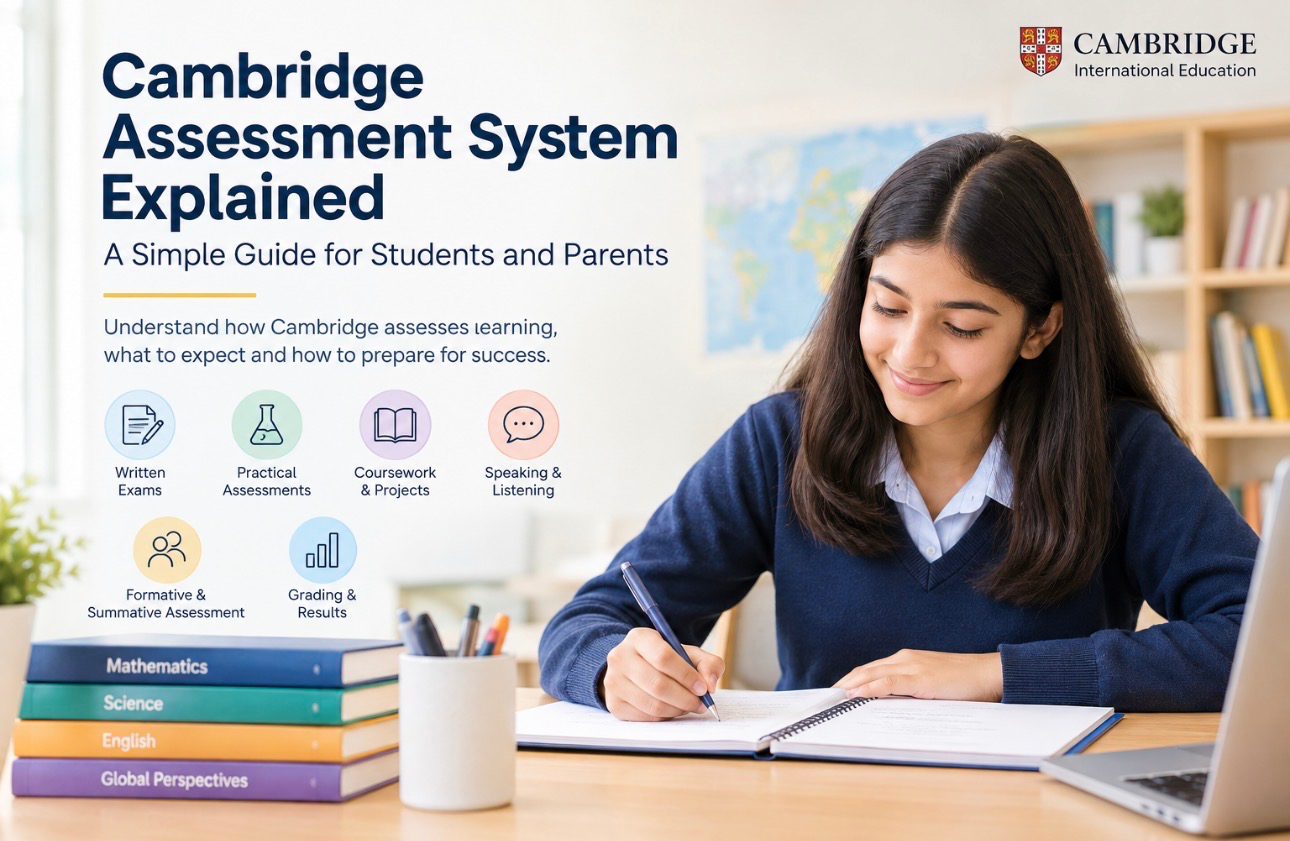
Cambridge Assessment System Explained: A Simple Guide for Students and Parents
The Cambridge assessment system is an important part of Cambridge education. For students and parents, understanding how assessment works can make the curriculum much easier to follow.
Cambridge qualifications include programmes such as IGCSE, AS Level and A Level. Students are assessed according to the requirements of their particular subject. In many cases, this includes written examinations, while some subjects may also involve practical work, coursework, speaking, listening or other forms of assessment.
The exact format depends on the subject, so there is no single examination pattern for every Cambridge course.
What Is the Cambridge Assessment System?
The Cambridge assessment system is the framework used to measure what students have learned during their course.
Assessment can look at both knowledge and understanding. Depending on the subject, students may be asked to remember information, explain concepts, solve problems, analyse data or apply what they have learned to a new situation.
This means students need to understand their subjects rather than depend entirely on memorisation.
How Does Cambridge Assessment Work?
The process starts with classroom learning.
Students study the topics included in their syllabus and complete different activities throughout the academic year. Teachers may use classwork, homework, short tests, assignments and practical activities to monitor progress.
Formal assessment comes later and follows the requirements of the relevant Cambridge syllabus.
The assessment method can include:
Written examinations
Practical assessments
Coursework
Projects
Speaking tests
Listening tests
Oral assessments
Not every subject includes all of these. Students should check the syllabus for their particular course to understand exactly what will be assessed.
What Is Assessed in Cambridge Courses?
Cambridge assessments can test several types of knowledge and skills.
Students may need to:
Recall important information
Explain ideas clearly
Apply knowledge
Solve problems
Analyse information
Interpret data
Compare different ideas
Evaluate evidence
Give reasons for their answers
The balance between these skills depends on the subject.
For example, a mathematics assessment may require students to solve problems, while a language course may place more emphasis on communication skills.
Does Cambridge Assessment Focus on Memorisation?
Students do need to remember important information. Facts, definitions, formulas and key concepts are still part of learning.
However, knowing something is not always enough.
A question may give students information they have not seen before and ask them to use what they already know to reach an answer.
For example, a student might learn a scientific principle in class and later be asked to use that principle to explain the result of an experiment.
This is why understanding the subject is so important.
Formative Assessment During the School Year
Assessment does not only happen at the end of a course.
Teachers can use formative assessment during the school year to understand how students are progressing.
This can include:
Short quizzes
Class exercises
Homework
Assignments
Discussions
Practice tests
Practical activities
The purpose is to identify strengths and areas where students need more help.
If a student is struggling with a particular topic, the teacher can provide additional explanation or practice before the final examination.
What Is Summative Assessment?
Summative assessment is used to measure what a student has achieved after completing a course or stage of learning.
Cambridge examinations are an example of summative assessment.
The final assessment structure depends on the subject. Some courses may be assessed mainly through written papers, while others can include additional components.
This is why students should always refer to their specific syllabus when preparing for examinations.
Practical and Other Forms of Assessment
Written examinations cannot measure every skill.
Some Cambridge subjects therefore include practical, oral or other forms of assessment where appropriate.
For example, certain science subjects may include practical assessment. Language courses can include speaking or listening components. Some subjects may also have coursework or project work.
These different methods allow students to demonstrate skills that may not be fully shown in a written examination.
How Are Cambridge Exams Marked?
Cambridge assessments are marked according to the requirements of the relevant qualification and subject.
Cambridge uses established assessment and marking procedures to support consistency.
Students receive results according to the grading system for their qualification.
However, grading and assessment arrangements can vary between subjects. There is no single grading rule that applies in exactly the same way to every Cambridge course.
For accurate information, students and parents should check the official assessment details for the specific subject.
Why Is Understanding Important?
A good understanding of a subject can make it easier for students to answer different types of questions.
Suppose a student memorises the definition of a term. They may be able to answer a direct question about it.
But if the question asks them to apply the idea to a new example, they need to understand what the term actually means.
This is one reason students should combine reading and revision with question practice.
How Should Students Prepare?
There is no single study method that works for everyone, but a few habits can help.
Understand the Syllabus
Students should know what topics and skills are included in their course.
Study Regularly
Regular study is generally easier to manage than trying to cover everything shortly before an examination.
Practise Questions
Practice helps students become familiar with different question formats and identify areas they find difficult.
Review Mistakes
An incorrect answer can be useful if the student understands why it was wrong and how to improve it.
Ask for Feedback
Teachers can help students understand where they are losing marks and what they can do differently.
Manage Time
Students should also practise completing questions within the available examination time.
Is the Cambridge Assessment System Difficult?
The answer depends on the student and the subject.
Students who are new to Cambridge may find some questions unfamiliar, particularly if they have mainly studied through memorisation before.
With regular practice, however, students can become more comfortable with questions that require explanation, application and analysis.
Good teaching and regular feedback can also make a difference.
What Should Parents Know?
Parents do not need to know every detail of the Cambridge examination process.
It is useful, however, to understand how their child’s subjects are assessed.
Parents can ask the school:
Which Cambridge programme does my child study?
Which subjects are available?
How is each subject assessed?
Are practical or coursework components included?
How does the school provide feedback?
What academic support is available?
What options are available after IGCSE?
These questions can help parents understand what their child can expect during the course.
Frequently Asked Questions
What is the Cambridge assessment system?
It is the framework Cambridge uses to assess students studying qualifications such as IGCSE, AS Level and A Level. The assessment method varies according to the subject.
Are Cambridge assessments only written exams?
No. Some subjects can also include practical work, coursework, projects, speaking or listening assessments.
Does Cambridge require memorisation?
Students need to learn important subject knowledge, but they may also need to apply, analyse and explain what they have learned.
What is formative assessment?
Formative assessment takes place during learning. It helps teachers understand student progress and identify areas that need improvement.
What is summative assessment?
Summative assessment measures achievement after a period of learning. Formal examinations are one example.
Do all Cambridge subjects have practical assessments?
No. Practical assessment depends on the individual subject and its syllabus.
How can students prepare for Cambridge exams?
Students should understand their syllabus, study regularly, practise relevant questions, review mistakes and use teacher feedback to improve.
Are Cambridge qualifications recognised internationally?
Cambridge qualifications are offered internationally and are recognised by many educational institutions. However, university requirements vary, so students should check the entry requirements of the institutions they are interested in.
Final Thoughts
The Cambridge assessment system is not one fixed examination format. Each subject has its own assessment requirements, and students may be assessed through written examinations, practical work, coursework, speaking, listening or other components.
The best preparation starts with understanding the syllabus.
Students should know what they are expected to learn, practise applying their knowledge and use feedback to improve.
For parents, understanding the assessment structure of each subject can make it easier to support their child throughout the school year.