
Cambridge International Education: Benefits, Curriculum, IGCSE & A Level Explained
3 October 2026
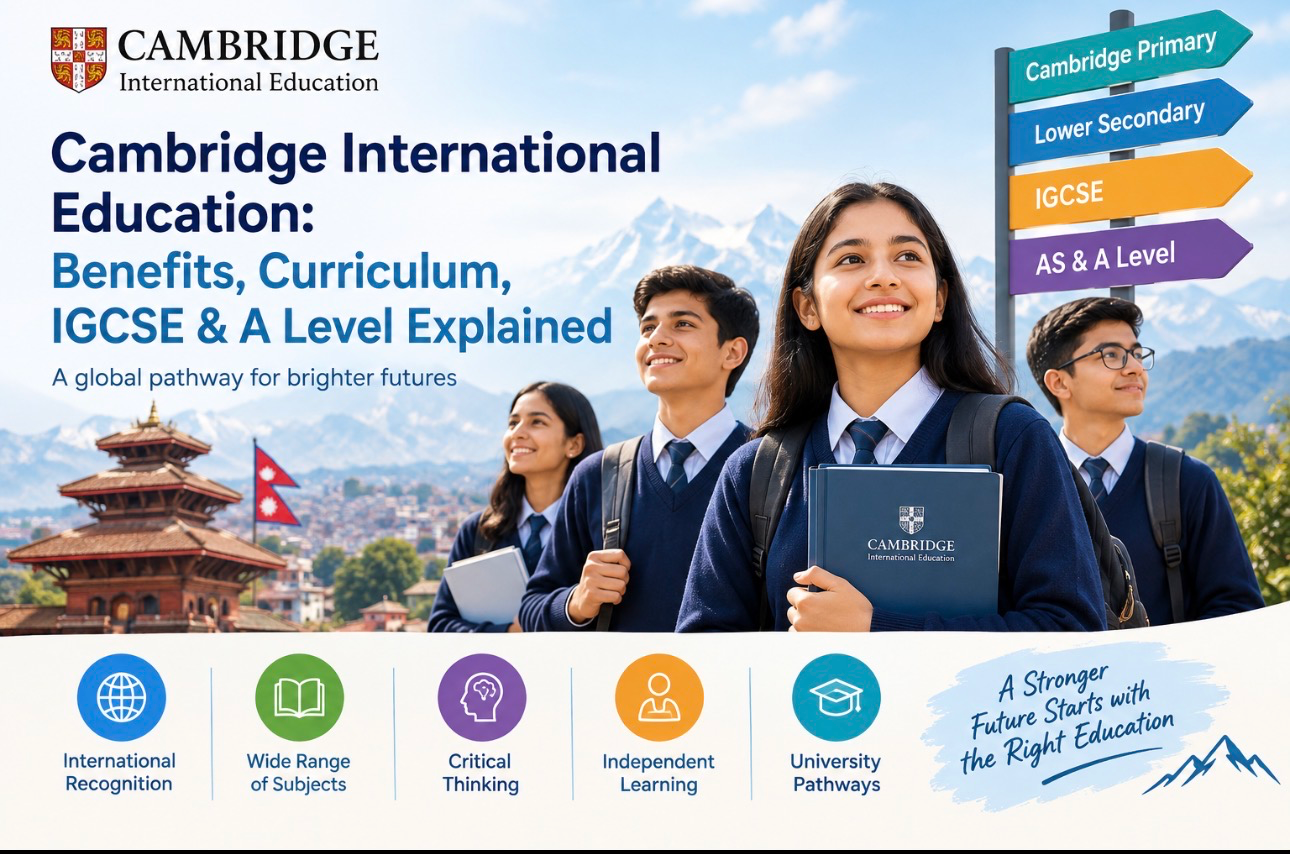
Cambridge International Education: Benefits, Curriculum, IGCSE & A Level Explained
Choosing the right education system is an important decision for parents, students and schools. Today, education is about more than passing examinations. Students also need strong subject knowledge, practical skills, confidence and the ability to think independently.
This is one reason Cambridge International Education has become a popular international education pathway.
Cambridge offers programmes and qualifications for learners from the early years through secondary and advanced education. Its pathway includes Cambridge Early Years, Cambridge Primary, Cambridge Lower Secondary, Cambridge IGCSE, Cambridge O Level and Cambridge International AS & A Level.
But what does a Cambridge education actually offer? How does the Cambridge curriculum work? What are Cambridge IGCSE and A Level? And what should parents consider before choosing a Cambridge school?
This guide explains the main points in simple, practical language.
What Is Cambridge International Education?
Cambridge International Education is part of Cambridge University Press & Assessment, which is part of the University of Cambridge.
It provides international education programmes and qualifications for learners from around 3 to 19 years of age.
Cambridge brings curriculum, teaching, learning resources and assessment together within its educational framework. It also provides professional development and support for teachers and schools.
The aim is to give schools a clear academic framework while allowing them to adapt learning to their students and local context.
This is important because schools in different countries have different cultures, education systems and student needs.
Understanding the Cambridge Pathway
One of the easiest ways to understand Cambridge education is through the Cambridge Pathway.
It provides a progression through different stages of learning.
Cambridge Early Years
Cambridge Early Years focuses on the development of young learners.
Children begin building communication, social, emotional and early academic skills that prepare them for primary education.
Cambridge Primary
At the primary stage, students develop foundations in subjects such as English, mathematics and science, along with other available subjects.
The focus is on building knowledge while helping children develop positive learning habits.
Cambridge Lower Secondary
Students at this stage move towards more advanced academic learning.
They continue developing subject knowledge while strengthening skills such as analysis, problem-solving and independent learning.
Cambridge IGCSE
Cambridge IGCSE is a well-known secondary-level qualification offered in a wide range of subjects.
Students can choose subjects according to their interests, strengths and future plans.
The programme encourages students to develop subject knowledge as well as the ability to apply what they learn.
Cambridge International AS & A Level
At the advanced stage, students can study selected subjects in greater depth through Cambridge International AS & A Level.
A Level qualifications are commonly used as preparation for higher education.
Because students study subjects in greater detail, subject selection becomes important. Students should consider their interests and possible university requirements before making their choices.
What Makes the Cambridge Curriculum Different?
The Cambridge curriculum places importance on understanding rather than learning information only for an examination.
Students are encouraged to understand concepts and apply their knowledge.
For example, a science student may need to explain why something happens, not simply remember a definition.
A mathematics student may need to understand how a method works and use it to solve a new problem.
A history student may need to examine evidence and explain why an event was important.
This approach can help students develop a deeper understanding of their subjects.
Developing Critical Thinking
Students today have access to more information than ever before.
The challenge is not simply finding information. It is knowing how to understand and evaluate it.
Students need to ask:
Is this information reliable?
What evidence supports it?
Are there other possible explanations?
How can I use this information?
Cambridge programmes place importance on skills such as analysing information, evaluating evidence, constructing arguments and applying knowledge.
These skills can be useful in further education, employment and everyday life.
Cambridge Learner Attributes
Cambridge identifies five learner attributes:
Confident
Responsible
Reflective
Innovative
Engaged
These attributes describe qualities that can support students throughout their education.
A confident learner can express ideas and ask questions.
A responsible learner takes ownership of their actions and learning.
A reflective learner thinks about what they have learned and where they can improve.
An innovative learner explores new ideas and solutions.
An engaged learner takes an active interest in learning.
These qualities complement academic knowledge and help create a broader approach to student development.
Are Cambridge Qualifications Recognised Internationally?
International recognition is an important consideration for many families.
Cambridge states that its qualifications are recognised and valued by universities and higher education institutions around the world.
This can be useful for students considering higher education in different countries.
However, recognition does not mean that every university has identical admission requirements.
Universities can set their own requirements based on the country, degree and institution. Some courses may require specific subjects or grades.
Students should therefore check the official requirements of their preferred universities before selecting subjects.
What Is Cambridge IGCSE?
Cambridge IGCSE is an internationally used secondary-level qualification.
It offers a broad choice of subjects, allowing schools to create different academic pathways.
Subject selection can be particularly important for students who already have an idea about their future studies.
For example, students considering medicine, engineering, computer science, business or other specialised areas may need particular subjects later.
Students do not need to have their entire career planned during secondary school, but understanding possible future options can help them make informed choices.
What Is Cambridge International AS & A Level?
Cambridge International AS & A Level provides advanced subject study.
Unlike earlier stages, students normally study a smaller number of subjects in greater depth.
This allows them to build stronger knowledge in areas that may connect with their intended university course.
A Level study also requires students to manage their time, read independently and take greater responsibility for their academic progress.
These habits can help prepare students for university-level study.
How Does Cambridge Assessment Work?
Assessment is an important part of any academic programme.
Cambridge describes its assessment approach as focusing on areas such as subject knowledge, conceptual understanding and higher-level thinking.
This means assessment is not simply about remembering facts. Students may need to explain ideas, apply knowledge, analyse information or solve problems.
Assessment results can also help schools identify areas where students need additional support.
The aim is to make assessment a useful part of learning rather than simply a final score.
Support for Teachers and Schools
A curriculum only works well when teachers understand how to use it.
Cambridge provides professional development, teaching resources and support for educators and school leaders.
This can help teachers understand programme requirements, plan lessons and prepare students for assessment.
Teacher development is particularly important when a school introduces Cambridge programmes for the first time.
The quality of classroom teaching remains a major part of the student’s educational experience.
The School Matters as Much as the Curriculum
For parents, this is an important point.
Choosing a Cambridge school does not mean every school will provide exactly the same experience.
The individual school, teachers and learning environment make a significant difference.
Parents should consider:
Teacher experience and training
Class size
Subjects available
Learning resources
School facilities
Student support
Examination preparation
Co-curricular activities
University and career guidance
Communication with parents
A strong curriculum provides a framework, but teachers and schools determine how students experience that curriculum every day.
Independent Learning at IGCSE and A Level
As students become older, they are expected to take more responsibility for their studies.
This can include:
Planning study time
Reviewing lessons
Reading independently
Practising questions
Asking for help
Preparing for assessments
Managing several subjects
This does not mean students are expected to learn without support.
Teachers and parents continue to guide them. The difference is that students gradually become more responsible for their own progress.
This is an important preparation for higher education.
Preparing Students for University
Cambridge qualifications can provide a pathway towards higher education, including universities in different countries.
However, university preparation is about more than obtaining a qualification.
Students also need skills such as:
Academic writing
Research
Critical thinking
Communication
Time management
Problem-solving
Independent study
Developing these skills during school can make the transition to university easier.
Students planning to study abroad should also research admission requirements early, especially when selecting IGCSE and A Level subjects.
Preparing for a Changing Future
Students today are preparing for a world that is changing quickly.
Technology, artificial intelligence, global communication and new industries are changing the way people work.
Students cannot predict exactly what their future careers will look like.
What they can develop is the ability to learn and adapt.
This includes being able to understand new information, solve unfamiliar problems, communicate clearly, work with others and make informed decisions.
Cambridge highlights future-readiness as an important part of education and considers how schools can prepare learners for technological, environmental and global changes.
International Education and Local Identity
An international curriculum does not have to mean losing connection with local culture.
Students can follow an international academic programme while continuing to learn about their own country, history, language and community.
For schools in Nepal, this balance can be particularly useful.
Students can develop an international outlook while remaining connected to Nepal and its society.
International education can therefore provide a wider perspective without replacing local identity.
Climate Change and Global Issues
Education also has a role in helping students understand major global issues.
Climate change, environmental protection and sustainability are becoming increasingly important areas of public discussion and professional work.
Cambridge highlights climate change education as part of its broader work on preparing learners for the future.
These topics can also connect different subjects.
Science can explain environmental processes. Geography can explore their impact. Economics can examine social and financial effects.
This helps students understand how different areas of knowledge connect to real-world problems.
Inclusive Education
Students have different abilities, backgrounds and learning needs.
A good school should provide an environment where students feel safe, respected and supported.
Cambridge identifies inclusion and accessibility as important areas of education.
For parents, it is useful to look at how an individual school supports students who need additional academic or learning assistance.
The most important question is not simply whether a school follows an international curriculum, but whether students receive the support they need to learn successfully.
Cambridge International Education in Nepal
For families in Nepal, Cambridge education can provide an international academic pathway for students considering higher education in Nepal or abroad.
Cambridge qualifications have international recognition, but students should still check the requirements of their preferred universities.
This is particularly important when choosing A Level subjects.
For example, some university courses may require specific science, mathematics or other subjects.
Students who have an idea about their future field should therefore research university requirements before making final subject choices.
Schools can also support students through academic counselling and university guidance.
Nepal-Focused Decision Checklist for Parents
Choosing a Cambridge school in Nepal involves more than looking at the curriculum name. A practical checklist can help families make a more informed decision.
1. Check Which Cambridge Programme the School Offers
First, identify the exact programme available.
Does the school offer:
Cambridge Primary?
Cambridge Lower Secondary?
Cambridge IGCSE?
Cambridge International AS & A Level?
A complete pathway from lower levels to A Level?
This matters because not every Cambridge school offers the same stages.
2. Check Subject Availability
Subject choices can differ between schools.
Before admission, ask for the current list of subjects available at IGCSE and A Level.
If your child is interested in areas such as medicine, engineering, IT, business or another specialised field, check whether the school offers the subjects that may be relevant to future study.
3. Look at Teacher Experience
Ask about the teachers who will actually teach your child.
Useful questions include:
How experienced are the teachers?
Do they receive Cambridge-related professional development?
How long have they taught the relevant subject?
How does the school support teacher development?
The curriculum is important, but classroom teaching has a direct effect on the student’s daily learning experience.
4. Understand the Full Cost
Do not look only at the advertised tuition fee.
Consider the complete cost of education, including:
Tuition
Examination fees
Books and learning materials
Transportation
Uniforms
Activities
Technology requirements
Other school-related expenses
The total cost can vary considerably between schools, so it is useful to understand the full financial commitment before enrolling.
5. Ask About Examination Support
Find out how the school prepares students for Cambridge examinations.
Ask about:
Mock examinations
Revision programmes
Academic support
Past-paper practice
Individual feedback
Support for students who are struggling
This can give parents a better understanding of how the school approaches assessment preparation.
6. Check University and Career Guidance
If your child may study in Nepal or abroad, ask how the school supports future planning.
Find out whether students receive guidance on:
University applications
Subject selection
Course requirements
Application timelines
Scholarships
Career options
Good guidance can be especially useful when students are selecting A Level subjects.
7. Research Future Admission Requirements
Do not wait until the final year to research university requirements.
If your child has a possible university or career direction, check the relevant requirements early.
Requirements can differ by university, country and course. Subject choices made at IGCSE and A Level may therefore have long-term importance.
8. Look at Student Support
Academic performance is only one part of school life.
Ask how the school supports students who need additional academic, learning or pastoral support.
You can also ask how the school handles:
Student wellbeing
Learning difficulties
Academic pressure
Communication with parents
Individual learning needs
9. Visit the School
If possible, visit the school before making a decision.
Look beyond buildings and facilities.
Pay attention to:
Classroom atmosphere
Teacher-student interaction
Student behaviour
Learning environment
Library and laboratory facilities
Technology
Safety and general organisation
A school visit can provide information that a brochure or website cannot.
10. Speak With Current Parents or Students
If possible, talk to families who already have children at the school.
Ask about their actual experience with:
Teaching quality
Communication
Academic pressure
Student support
Examination preparation
School activities
Personal experiences are not universal, but they can provide another useful perspective.
11. Use Official Information
When making important academic decisions, rely on current information from official sources.
Check the school’s own information and Cambridge’s official programme and qualification information.
For university admission, check the university’s own requirements rather than relying only on social media posts or informal advice.
12. Consider Your Child’s Learning Style
A curriculum may look attractive on paper but still not suit every student.
Think about whether your child enjoys:
Academic study
Reading and writing
Problem-solving
Independent learning
Subject-based learning
Regular assessment
Also consider what kind of support your child needs to perform well.
13. Compare Schools, Not Just Curriculum Names
Two schools can follow the same Cambridge programme but offer different learning experiences.
When comparing schools, consider the complete picture:
Curriculum + teachers + subjects + support + facilities + fees + environment + future guidance
This gives parents a more realistic basis for comparison.
14. Think Beyond IGCSE
If your child is entering IGCSE, do not consider only the next two years.
Ask what happens afterward.
Does the school offer A Level?
If not, where do students normally continue?
Understanding the full pathway can prevent difficulties when students reach the next stage.
15. Consider the Long-Term Pathway
Finally, think about where your child’s education may lead.
A student may eventually study at a university in Nepal, India, the UK, Australia, the USA or another country.
Plans can change, but understanding possible pathways early can help students make better academic choices.
A Simple Final Check for Nepali Parents
Before making the final decision, ask yourself these five questions:
Does this school offer the right Cambridge programme for my child?
Are the available subjects suitable for my child’s interests and possible future plans?
Can our family comfortably manage the full cost of education?
Does the school provide the teaching, guidance and support my child needs?
Have we checked the requirements for the next stage of education?
If you can answer these questions clearly, you will have a much better understanding of whether the school fits your family’s needs.
What Should Students Consider?
Students should also have a voice in choosing their educational pathway.
They can think about:
Which subjects do I enjoy?
What are my academic strengths?
What subjects might I need for university?
Do I enjoy independent study?
What kind of learning environment suits me?
What support do I need?
Students do not need to know exactly what career they want at a young age.
However, understanding their interests can help them make better academic decisions.
Main Benefits of Cambridge International Education
The key features of a Cambridge education include:
International recognition
Cambridge qualifications are recognised and valued by universities and higher education institutions internationally.
Subject choice
Cambridge offers a broad range of subjects across its different stages.
Structured progression
The Cambridge Pathway provides a progression from early years through advanced study.
Deeper subject understanding
Students are encouraged to understand concepts and apply their knowledge.
Critical thinking
Students develop skills in analysing information and evaluating evidence.
Independent learning
Older students gradually take more responsibility for their academic progress.
Global perspective
Students become part of an international education community.
Teacher support
Schools and teachers can access professional development and educational resources.
These features should be considered alongside the quality of the individual school and the needs of the student.
Things to Consider Before Choosing Cambridge
A balanced decision should also consider practical factors.
Cambridge programmes can require regular study and a strong commitment to academic work.
Some subjects involve considerable reading, writing, analysis and problem-solving.
Costs can also vary significantly between schools.
Subject availability is not the same everywhere, and university requirements can differ between courses and countries.
Parents should therefore compare schools carefully rather than choosing a programme based only on its international reputation.
Is Cambridge International Education Right for Every Student?
There is no single curriculum that suits every learner.
Some students may enjoy a structured academic programme with opportunities to study subjects in depth.
Others may prefer a different approach.
Parents should consider their child’s:
Interests
Academic strengths
Learning preferences
Future plans
Support needs
Family budget
Possible university pathway
The right choice is ultimately the one that fits the student’s needs and the family’s educational goals.
Frequently Asked Questions
What is Cambridge International Education?
Cambridge International Education provides international education programmes and qualifications for learners from early years through advanced study.
What is Cambridge IGCSE?
Cambridge IGCSE is a secondary-level international qualification available in a wide range of subjects.
What is Cambridge A Level?
Cambridge International AS & A Level provides advanced study in individual subjects and can prepare students for higher education.
Are Cambridge qualifications recognised internationally?
Yes. Cambridge states that its qualifications are recognised and valued by universities and higher education institutions around the world. Individual universities may have their own admission requirements.
Is the Cambridge curriculum difficult?
The level of difficulty depends on the subject, stage and individual student. Consistent study and good understanding are important.
Is Cambridge suitable for students who want to study abroad?
Cambridge qualifications have international recognition and are used by students applying to universities in different countries. Students should still check the admission requirements of their preferred universities.
Does every Cambridge school offer the same subjects?
No. Subject availability varies between schools.
Does Cambridge focus only on examinations?
No. Its approach also includes curriculum, teaching, learning resources, student development and higher-level thinking.
Conclusion
Cambridge International Education provides a structured international pathway from early education to advanced study.
Its programmes combine academic knowledge with skills such as analysis, problem-solving, independent learning and communication. Qualifications such as Cambridge IGCSE and Cambridge International AS & A Level are also recognised by universities and higher education institutions around the world.
However, choosing a curriculum is only the beginning.
For families in Nepal, the school itself deserves careful attention. Parents should look at the available programmes, subjects, teachers, fees, facilities, student support, examination preparation and university guidance.
Students should also consider their interests, strengths and possible future plans.
A good decision is not simply about choosing an internationally recognised curriculum. It is about finding an educational environment where the student can learn effectively, develop confidence and prepare for the next stage.
A good education should prepare students not only for their next examination, but also for the next stage of their lives.
It should help them understand what they learn, think carefully, communicate their ideas, solve problems and remain willing to learn.
That is the wider value of education—and the reason the choice of curriculum deserves careful consideration.