
The Complete Assessment Cycle: A Simple Guide to Student Learning
2 October 2026
Introduction
If you ask a student what “assessment” means, there is a good chance they will say, “an exam.”
That is understandable. Exams are probably the most visible form of assessment in education. Students prepare for them, teachers mark them, parents look at the results, and schools use the grades to understand achievement.
But assessment is about much more than a final score.
For teachers, assessment can provide useful information about how students are actually learning. It can show what a learner already understands, where they are struggling, whether a teaching approach is working, and what kind of support they may need next.
When this information is used properly, assessment becomes part of teaching rather than something that happens only at the end.
This is the idea behind the complete assessment cycle.
What Is the Assessment Cycle?
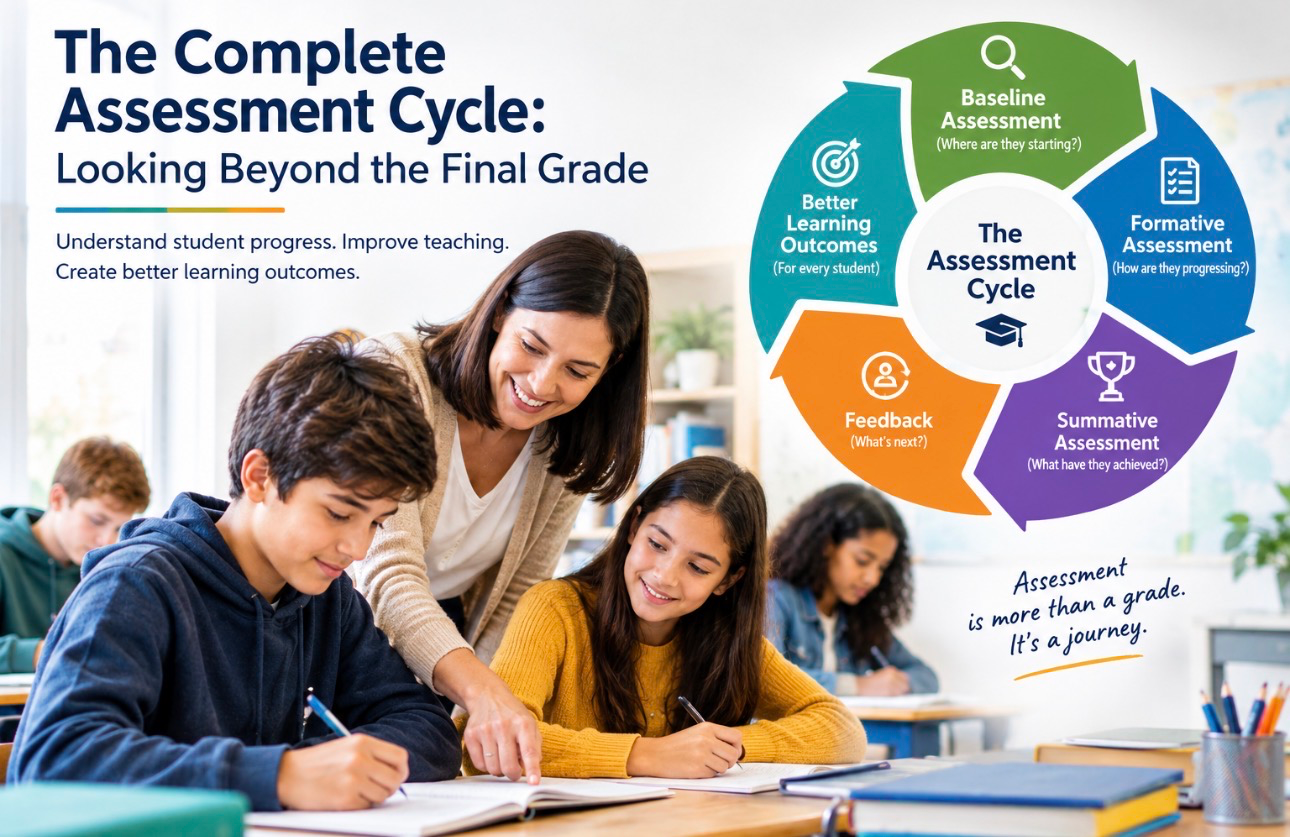
The assessment cycle is a continuous process that helps teachers understand student learning and make better decisions about teaching.
The Three Main Stages
The assessment cycle generally involves three important stages:
Baseline assessment – finding out where students are starting
Formative assessment – checking progress during learning
Summative assessment – measuring achievement at the end
These stages are different, but they work together. Information from one stage can help teachers make decisions in the next.
The goal is not simply to test students more often. The goal is to make assessment useful.
1. Start by Understanding Your Students
Every classroom contains students with different experiences, abilities, and levels of knowledge.
Some students may already feel confident with a subject. Others may need to revisit basic ideas before they can move forward.
This is where baseline assessment can be helpful.
What Is Baseline Assessment?
Baseline assessment usually takes place at the beginning of a course, school year, or new stage of learning. It gives teachers an early picture of what students already know and what they may need to work on.
For example, a teacher starting a mathematics course might discover that most students understand basic calculations, while several students need more support with problem-solving.
Knowing this from the beginning can make lesson planning much more effective.
The Key Question
The important question is:
“Where are my students starting from?”
Baseline assessment can also provide a reference point for measuring progress later.
2. Why the Starting Point Matters
A final result does not always tell the complete story.
Imagine two students who receive similar grades at the end of the year. On paper, their results look almost identical.
However, one student may have started the year with strong knowledge of the subject, while the other began with significant gaps and gradually improved throughout the year.
Their final grades may be similar, but their learning journeys were very different.
This is why knowing the starting point matters.
Baseline information gives teachers some context when they later look at student progress.
It allows them to consider not only where students finished, but also how far they have travelled.
3. Keep Checking During Learning
Assessment should not stop after the first test.
Students learn gradually. They make mistakes, ask questions, practise new skills, and sometimes need an idea explained in a completely different way.
This is where formative assessment becomes important.
What Is Formative Assessment?
Formative assessment happens during the learning process. It helps teachers find out whether students understand what they are being taught.
It does not always need to be a formal test.
A teacher might:
Ask students to explain an answer
Review their classwork
Give a short quiz
Observe group activities
Ask questions during a lesson
Check homework
Discuss a difficult topic with the class
These small checks can provide valuable information.
4. A Small Classroom Moment Can Reveal a Lot
Imagine a teacher has just explained a new mathematical concept.
The classroom is quiet. Students appear to be listening, so everything seems fine.
Then the teacher gives them two short questions.
Several students make the same mistake.
That is useful information.
It suggests that the concept may not have been fully understood. Instead of continuing to the next topic, the teacher can pause and explain the idea in another way.
Students can then try again.
This is formative assessment at work.
The teacher has discovered a problem while there is still time to do something about it.
That is one of the biggest advantages of formative assessment.
5. Feedback Should Help Students Improve
Assessment becomes even more useful when students receive clear feedback.
Simply giving a student a mark does not always explain what they should do next.
For example, a student might receive 65% on an essay. The number tells them how they performed, but it does not necessarily tell them how to improve.
A useful comment might explain that their main argument is clear but needs stronger evidence.
Now the student has something specific to work on.
Good feedback does not have to be long. It needs to be clear and useful.
How Feedback Supports Learning
Over time, feedback can also help students become more independent learners.
They can begin to recognise their own strengths, identify areas for improvement, and think about what they should do differently next time.
6. Measuring Achievement at the End
After students have had time to learn and practise, it is important to measure what they have achieved.
This is the role of summative assessment.
What Is Summative Assessment?
Summative assessment usually takes place at the end of a course, term, school year, or learning stage.
Examples include:
Final examinations
End-of-course tests
Formal qualifications
Final projects or assessments
These assessments provide evidence of what students have achieved at a particular point in time.
They can show whether students have reached expected learning outcomes and what level of knowledge or skill they have demonstrated.
Why Final Assessment Matters
Final assessments are important, but they should not be viewed in isolation.
A final grade is one piece of information. The complete assessment cycle gives teachers much more context.
7. Bring the Different Assessments Together
The real value of assessment comes from connecting the different stages.
First, teachers establish a starting point through baseline assessment.
Then they monitor learning through formative assessment.
Finally, they measure achievement through summative assessment.
A Simple Example
A teacher may discover through baseline assessment that a student has difficulty with a particular skill.
During the year, formative assessment can show whether the student is improving.
At the end of the course, the summative assessment provides another measure of achievement.
Together, these results tell a much clearer story than any single test could provide.
8. What Should Happen After Assessment?
This is an important part of the process.
Assessment results are only useful if they lead to action.
If students are struggling with a topic, the teacher may need to revisit it.
If a student has made significant progress, they may be ready for more challenging work.
If an entire class is having difficulty with the same concept, the teacher may need to consider whether the topic needs more teaching time or a different approach.
Assessment Should Lead to Decisions
In other words, assessment should lead to decisions.
It should help teachers decide what to do next.
9. Why Is It Called a Cycle?
The word “cycle” matters because assessment does not simply end with a final exam.
The information gathered at one stage can influence what happens next.
The Assessment Cycle in Simple Terms
Assess → Plan → Teach → Check → Respond → Measure → Begin Again
The end of one learning period can become the starting point for the next.
This makes assessment a continuous part of education rather than a one-time event.
Looking at Progress in a Different Way
It is easy to focus on one question:
“What grade did the student get?”
But there are other questions that may be just as important:
Where did the student begin?
What have they learned?
How much progress have they made?
What difficulties remain?
What support could help them improve?
What should they learn next?
These questions shift attention from simply measuring students to understanding their learning.
They also recognise something important: students develop over time.
A single test result cannot always capture that development.
Assessment Should Help, Not Just Measure
Schools already use many different forms of assessment. The answer is not necessarily to give students more tests.
The bigger goal is to make assessment meaningful.
When baseline, formative, and summative assessment work together, teachers can build a clearer picture of student learning.
Students can receive more useful feedback. Teachers can adjust their teaching. Schools can identify areas where additional support may be needed.
Most importantly, assessment can help learning move forward.
Final Thoughts
The complete assessment cycle gives teachers a broader way to understand student progress.
Baseline assessment helps establish where a learner begins. Formative assessment provides information during the learning process. Summative assessment shows what the learner has achieved at the end.
When these stages are connected, assessment becomes more than a system for producing grades.
It becomes a way to understand students, improve teaching, and plan the next step.
A final grade can tell us where a student finished.
The complete assessment cycle helps us understand where they started, what happened along the way, and where they could go next.