
Continuous Assessment System for Grades 1–5: A Simple Guide for Schools, Teachers, and Parents
11 September 2026
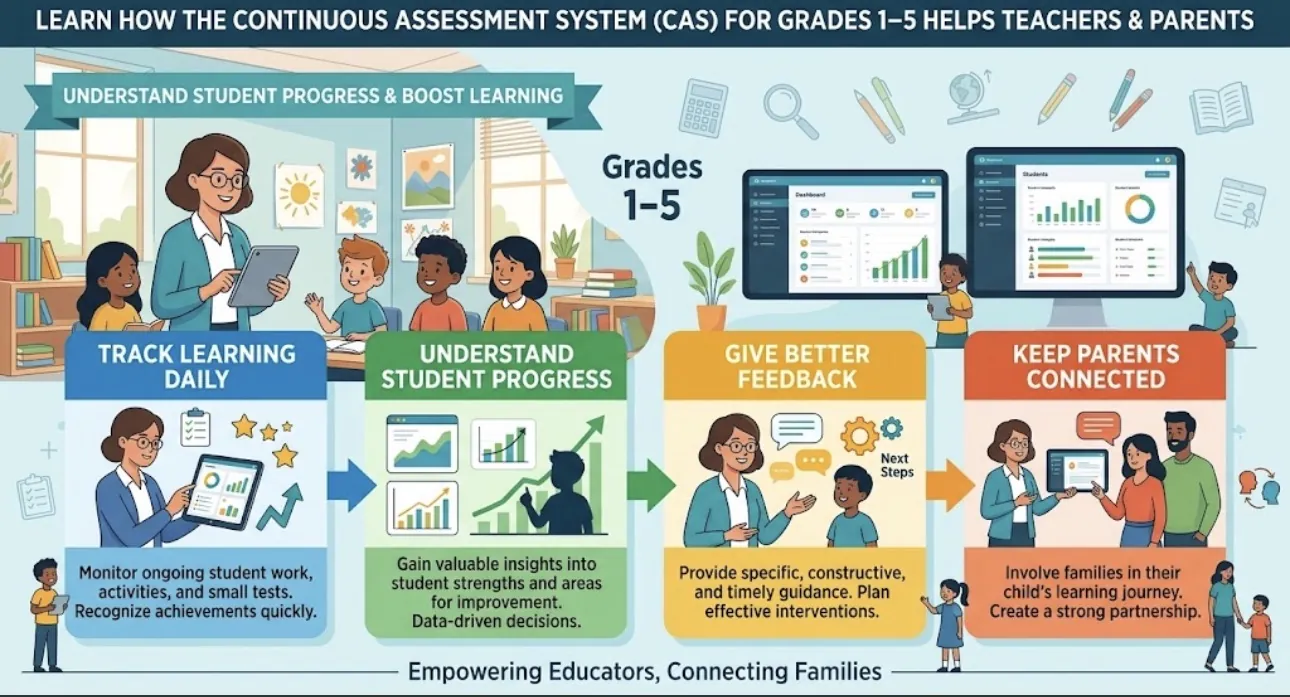
Continuous Assessment System for Grades 1–5: A Simple Guide for Schools, Teachers, and Parents
A child does not learn everything in one day.
Some children understand a lesson quickly. Others need more time, practice, or a different way of learning. Some students may be good at speaking but need help with writing. Another student may read well but have difficulty explaining what they have learned.
This is why looking only at a final examination or final grade does not always give a complete picture of a child’s learning.
The Continuous Assessment System for Grades 1–5 takes a different approach. Instead of waiting until the end of a term, teachers observe students and record their progress throughout the learning process.
The purpose is simple: understand where a child is today, identify where the child needs help, and support the child in moving forward.
What Is a Continuous Assessment System?
Continuous assessment means checking student learning regularly instead of depending on one final test.
A teacher may observe a student during classroom activities, ask questions, check classwork, listen to reading, watch a practical activity, review an assignment, or talk with the student.
These activities provide useful evidence about what the child can actually do.
For example, imagine a Grade 3 student learning English.
A written test may show that the student knows some vocabulary. But the teacher may also notice that the student can understand spoken English, participate in a conversation, and read a short paragraph.
All of this information is useful.
A good assessment system brings these different pieces of information together.
Why Is Continuous Assessment Important in Grades 1–5?
The primary school years are an important stage of learning.
Children are developing basic skills that they will use for many years. Reading, writing, speaking, listening, mathematics, problem-solving, social skills, and other competencies develop gradually.
A child who is struggling with one skill today may improve significantly with the right support.
Continuous assessment helps teachers notice these changes.
Instead of asking only:
“What grade did the student get?”
the teacher can ask:
“What has the student learned?”
“What is the student finding difficult?”
“What evidence do we have?”
“What should the student learn next?”
These questions make assessment more useful.
Assessment Should Be Part of Everyday Learning
Continuous assessment does not need to be a separate activity every day.
It can happen naturally during normal classroom work.
A teacher can observe students while they:
Read a story
Answer questions
Solve a mathematics problem
Work in groups
Give a short presentation
Complete an assignment
Write a paragraph
Take part in a practical activity
Explain an idea
Participate in classroom discussions
For a teacher, these small observations can provide valuable information.
The important thing is to record meaningful evidence rather than relying only on memory.
Start With Clear Learning Indicators
Teachers need to know what they are assessing.
A broad statement such as “Good in English” is difficult to measure.
A clearer indicator might be:
Reads a short passage with understanding
Answers simple questions about a story
Uses familiar words correctly
Speaks in simple sentences
Writes a short paragraph
Clear indicators make assessment easier for teachers and easier to understand for parents.
They also help schools maintain a common approach across different classrooms.
Use a Simple Assessment Rubric
A rubric gives teachers a common way to describe student performance.
For example, a school may use a four-level scale:
Level
Meaning
1
Below Basic
2
Basic
3
Proficient
4
Advanced
The exact wording can vary according to the school’s assessment framework.
The important thing is consistency.
If teachers use the same scale and understand what each level means, student records become easier to compare and understand.
A rubric also helps move the conversation away from simply saying that a child is “good” or “weak.”
Instead, the teacher can identify the specific skill and the current level of performance.
Evidence Makes Assessment More Meaningful
A score by itself does not always tell the full story.
For example, a student may receive a score of 2 for reading.
A parent may naturally ask:
“Why did my child receive 2?”
Evidence can help answer that question.
The teacher may have observed the student reading a passage and noticed difficulty with pronunciation and understanding some words.
This makes the assessment more transparent.
Evidence can include classroom observations, student work, assignments, activities, practical tasks, oral responses, projects, or other appropriate learning activities.
The goal is not to create more paperwork.
The goal is to have enough information to make a fair judgment about learning.
Give Students Feedback
Assessment should not end with a number.
Students need to know what they are doing well and where they can improve.
For example:
Instead of saying:
“Your writing is weak.”
A teacher could say:
“Your ideas are clear. Now work on using complete sentences and correct punctuation.”
That type of feedback gives the student something practical to work on.
It also makes assessment part of learning rather than simply a way of recording performance.
Find the Next Learning Step
One of the most useful parts of continuous assessment is identifying the next step.
Suppose a Grade 2 student can read simple sentences but struggles with longer sentences.
The next goal might be to practise reading short paragraphs.
Another student may already be reading confidently. That student may need more challenging material.
This means assessment can help teachers provide support according to the student’s actual needs.
Not every child has to move at exactly the same speed.
The Teacher’s Role
Teachers are at the centre of continuous assessment.
They observe students, collect evidence, record progress, provide feedback, and decide what support may be needed.
But teachers should not have to spend most of their time filling out complicated forms.
A useful system should make recording simple.
Teachers should be able to find their class, select a student, choose the relevant learning area or indicator, record the assessment, and add a short remark when necessary.
The system should support teaching rather than create another administrative burden.
The Parent’s Role
Parents also need clear information about their child’s progress.
A final report at the end of a term may not be enough.
Parents benefit from knowing:
What their child is learning
Which skills are developing well
Where the child needs support
What the teacher has observed
What the next learning goal may be
This creates a better connection between school and home.
Parents can then support learning in simple ways, such as reading together, practising writing, asking questions, or encouraging the child to explain what they learned at school.
Continuous Assessment Is Not About Creating Pressure
The word “assessment” can sometimes make people think about tests and pressure.
Continuous assessment should not mean giving children more examinations.
For primary students, assessment should be closely connected with learning.
The teacher observes, understands, records, and responds.
The purpose is improvement.
If a child has difficulty with a particular competency, the assessment should help the teacher decide what to do next.
That may mean additional practice, a different activity, individual support, group work, or remedial learning.
Remedial Support Matters
Sometimes a student needs another opportunity to demonstrate learning.
A good assessment process should make room for improvement.
If a student does not understand something during the first assessment, that does not necessarily mean the student cannot learn it.
With additional teaching and practice, the student may improve.
The new evidence should be considered when reviewing the student’s progress.
This is one of the important differences between a learning-focused assessment approach and an assessment system based only on one-time examinations.
Why Schools Need Organized Assessment Records
As a school grows, the amount of student information also grows.
Teachers may have dozens of students and many learning indicators to track.
Paper records can become difficult to maintain.
Information may be stored in different notebooks, spreadsheets, files, or forms.
A digital Continuous Assessment System for Grades 1–5 can bring these records together in one place.
Teachers can record assessments digitally, while school administrators can manage academic information and reports more easily.
Parents can also have a clearer way to understand their child’s progress when the school provides appropriate access.
Digital Continuous Assessment for Nepalese Schools
Technology can make continuous assessment easier, but technology should not make the process complicated.
A useful digital system should follow the school’s assessment structure.
For Nepalese primary schools, it is especially important that the system supports local school practices, subjects, learning indicators, assessment methods, student records, and reporting needs.
It should also keep each school’s information separate and secure.
The purpose of moving from paper to digital assessment is not simply to replace a paper form with a computer screen.
The real benefit is better organization.
Teachers can spend less time searching for records. Schools can prepare reports more efficiently. Parents can receive clearer information. Most importantly, teachers can have a better view of student progress.
Schools interested in a digital approach can explore Continuous Assessment System for Grades 1–5 through CAS Nepal.
Continuous Assessment vs. Final Examination
Continuous assessment and final examinations are not the same.
A final examination normally provides information about performance at a particular point in time.
Continuous assessment looks at learning over a period of time.
Here is a simple comparison:
Continuous Assessment
Final Examination
Happens throughout learning
Usually happens at a fixed time
Uses different types of evidence
Often depends mainly on an examination
Tracks progress
Measures performance at a specific point
Helps identify learning gaps earlier
May identify gaps later
Provides opportunities for feedback
Feedback may come after the examination
Focuses on development
Often focuses on final performance
For young children, understanding the learning journey is especially important.
What Should a Good CAS System Include?
A practical system for Grades 1–5 should be easy for teachers, administrators, and parents to understand.
Some important features include:
1. Student Records
Schools need accurate student information that can be updated when necessary.
2. Class and Section Management
Teachers should be able to work with the correct class and student list.
3. Learning Indicators
Schools should be able to organize the competencies and indicators they need to assess.
4. Rubric-Based Assessment
Teachers should have a clear and consistent scale for recording performance.
5. Evidence and Remarks
Teachers should be able to add useful notes or evidence where appropriate.
6. Progress Reports
Schools should be able to generate clear reports showing student development.
7. Parent Visibility
Parents should be able to understand their child’s progress without needing to interpret complicated data.
8. Secure School Data
Each school’s information should remain separate and accessible only to authorized users.
9. Easy-to-Use Interface
Teachers should not need advanced technical skills to record assessments.
The Main Goal Is Student Progress
The most important thing about continuous assessment is not the software, the report, or even the score.
It is the child.
A score is useful when it helps a teacher understand learning.
A report is useful when it helps a parent understand progress.
An assessment record is useful when it helps the school make a better decision.
That is why continuous assessment should always lead back to one question:
How can we help this child learn better?
Final Thoughts
The Continuous Assessment System for Grades 1–5 provides a more complete way to understand children’s learning.
Instead of waiting for a final examination, teachers can observe learning as it happens. They can record evidence, identify strengths, notice difficulties, provide feedback, and plan the next step.
For parents, this creates a clearer picture of what their children are learning.
For schools, organized assessment records can make reporting and monitoring easier.
And for students, assessment becomes less about a final number and more about learning, improvement, and progress.
Continuous assessment is not simply a different way to give grades.
It is a way to understand the learner better.
When assessment becomes part of everyday learning, schools can make better decisions, teachers can provide better support, and children can get the opportunity to keep improving.