
Continuous Assessment System in Nepal: The Gap Between Policy and Classroom Practice
11 September 2026
Continuous Assessment System in Nepal: The Gap Between Policy and Classroom Practice
Assessment is a normal part of school life. Teachers need to know what students have learned, where they are having problems, and what kind of help they need.
For this reason, Nepal has been using the Continuous Assessment System (CAS) as part of school education for many years.
The basic idea behind CAS is quite simple. A teacher should not wait for the final exam to find out whether a child is learning or not. The teacher should check learning regularly during normal classroom activities.
The teacher can ask questions, look at students’ work, observe their activities, give small tests, check homework, and talk with students. This gives the teacher a better picture of each child’s progress.
But there is a problem.
There can be a big difference between what the CAS policy says and what actually happens in the classroom.
What Is Continuous Assessment?
Continuous assessment means checking student learning regularly.
It is different from depending only on a final exam.
For example, a teacher may notice that a student is having trouble reading. Instead of waiting until the end of the term, the teacher can identify the problem early.
The teacher can then give the child extra reading practice and check the progress again later.
This is the main purpose of continuous assessment.
It is not only about giving marks.
It is about finding out how a child is learning and helping the child improve.
Why Is Continuous Assessment Important?
Every child learns differently.
Some children understand a lesson quickly. Others need more time and practice.
Some students are good at written work. Others may show better understanding when they speak, work in groups, draw, make something, or take part in activities.
A single examination cannot always show all of this.
Continuous assessment gives teachers more chances to see how students are learning.
It can help teachers answer simple questions such as:
What does this student understand?
Where is the student having difficulty?
What does the student need to practice?
Has the student improved?
Should I change the way I am teaching this topic?
These answers can help teachers make better decisions in the classroom.
CAS Should Be Part of Teaching
Continuous assessment should not be a separate job that teachers do only to complete records.
It should be part of everyday teaching.
For example, a teacher teaches a new reading lesson.
During the lesson, the teacher listens to students read.
The teacher notices that five students are struggling with some words.
The teacher makes a note of this and gives those students extra practice.
After a few days, the teacher checks them again.
This is continuous assessment in practice.
The assessment is directly connected to teaching.
The Problem: Policy and Practice Are Not Always the Same
Nepal has policies that support continuous assessment.
However, having a policy does not always mean that it is followed properly in every classroom.
This is one of the main issues discussed in research about CAS practice in Nepal.
The research looked at government schools in Bhaktapur and studied how teachers and school leaders understood and used continuous assessment.
The study covered six public schools. These included schools with different levels of performance.
Researchers talked with head teachers and teachers and also observed classroom teaching.
The findings point to an important issue: there is a gap between the idea of CAS and its actual use in some classrooms.
In simple words, the system may exist on paper, but it does not always work in the same way in practice.
Why Does This Happen?
There are several possible reasons.
Teachers Need More Practical Support
Knowing what CAS means is not enough.
Teachers also need to know how to use it in a real classroom.
For example, teachers may need help with:
Observing students
Keeping simple records
Giving useful feedback
Finding learning problems
Using peer assessment
Writing short observation notes
Planning extra support
Using assessment results to improve teaching
Training should therefore be practical.
Teachers should be shown what to do, how to do it, and how it can fit into a normal school day.
Too Much Paperwork Can Be a Problem
Continuous assessment needs records.
But if teachers have to fill in too many forms, it can become difficult.
Teachers already have many responsibilities.
If CAS becomes mostly about completing paperwork, its real purpose can be lost.
The record should help the teacher.
It should not become an extra burden.
A simple system can make it easier for teachers to record important information without spending too much time on paperwork.
Feedback Matters
Giving a score is not the same as giving feedback.
For example, telling a student:
“You got 2 marks.”
does not explain what the student should do next.
A better comment could be:
“You understand the main idea. Now practice explaining it in your own words.”
This tells the student what they are doing well and what they need to work on.
Good feedback helps students improve.
That is why feedback should be an important part of continuous assessment.
Remedial Teaching Should Follow Assessment
Finding a problem is only the first step.
The next step is helping the student.
Suppose a teacher finds that several students are struggling with addition.
Writing down their scores will not solve the problem.
The teacher needs to give them more practice.
The teacher might use objects, drawings, simple examples, games, or group activities.
After some practice, the teacher can check their learning again.
This is called remedial teaching.
The idea is simple:
Find the problem → Give support → Check again.
This is one of the most useful parts of continuous assessment.
Students Can Also Take Part
Assessment does not always have to come from the teacher.
Students can sometimes check and discuss each other’s work.
This is known as peer evaluation.
For example, two students can look at each other’s work and use simple questions such as:
Is the answer complete?
Is the work clear?
What was done well?
What could be improved?
This can help students learn from each other.
However, younger students need clear instructions and teacher support when doing peer evaluation.
Teachers Notice Many Things
Not everything a child learns can be seen through a written test.
A teacher may notice that:
A quiet child has started speaking in class.
A student is becoming more confident.
A child is helping classmates.
A student is struggling to follow instructions.
A child has found a new way to solve a problem.
A student who had difficulty reading is improving.
These small observations are useful.
Teachers can write short notes about important events or changes. These are sometimes called anecdotal records.
Over time, these notes can help teachers understand a child’s progress better.
CAS Should Look Beyond Marks
Children are not only exam scores.
They learn in different ways and show their learning in different ways.
A teacher may need to look at:
What students know
What they understand
How they communicate
How they work with others
How they solve problems
How they take part in activities
How they use practical skills
How their confidence changes
This gives a fuller picture of the child.
That is one of the reasons continuous assessment can be useful in primary education.
The Teacher Is Still the Most Important Part
Technology can help with assessment.
Digital tools can make it easier to record information, find student records, prepare reports, and see progress.
But technology cannot replace the teacher.
The teacher knows the classroom.
The teacher sees how students behave and take part.
The teacher understands the child’s situation.
The teacher decides what kind of support the child needs.
So, technology should make the teacher’s work easier. It should not take the teacher’s place.
How Can Schools Improve CAS?
Schools do not always need complicated solutions.
A few practical changes can make a difference.
Make the system simple
Teachers should be able to record important information quickly.
Give teachers practical training
Training should use real classroom examples.
Use different ways to assess
Teachers can use questions, observation, homework, group work, projects, short tests, and classroom activities.
Give regular feedback
Students should know what they are doing well and what they need to improve.
Provide extra help
Students who are struggling should get additional support.
Check how CAS is being used
School leaders should look at whether assessment is actually helping teachers and students.
Can Technology Make CAS Easier?
Yes.
A simple digital CAS system can help schools keep student records in one place.
Teachers can record assessment information without keeping large amounts of paper.
Schools can also review student progress over time.
A digital system can help with:
Student records
Learning indicators
Assessment records
Progress tracking
Student portfolios
Reports
Teacher records
Parent progress information
But the purpose should always remain the same.
Technology should make assessment easier, not make it more complicated.
The Most Important Question
There is one question every school should ask:
“What are we doing with the assessment information?”
This question is more important than simply asking whether a form has been completed.
If a student is struggling, what happens next?
If many students have the same problem, does the teacher change the lesson?
If a student improves, is that progress noticed?
If a child continues to struggle, does the school provide more help?
These are the things that make continuous assessment useful.
From Assessment to Action
A simple CAS process can look like this:
Observe the student
↓
Check the learning
↓
Record important information
↓
Give feedback
↓
Provide extra support
↓
Check progress again
↓
Improve teaching
This is the real purpose of continuous assessment.
Final Thoughts
Continuous Assessment System is not just about marks, forms, or records.
It is about understanding students while they are learning.
Nepal has had policies supporting continuous assessment for many years. But the real challenge is making sure the system is used properly in classrooms.
Teachers need practical training.
Schools need simple record-keeping methods.
Students need useful feedback.
Children who are struggling need extra support.
And assessment information needs to be used to improve teaching.
A completed assessment record should not be the final goal.
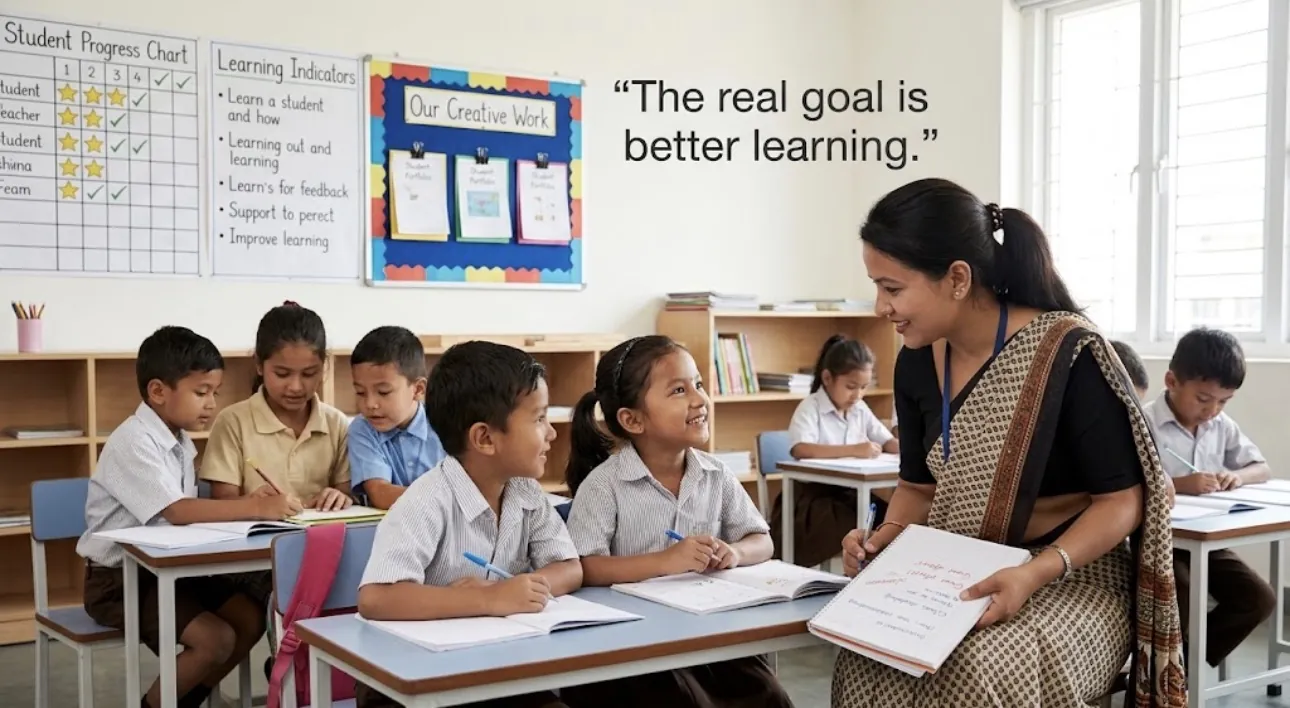
The real goal is better learning.
When teachers use assessment information to understand their students and help them improve, Continuous Assessment becomes a useful part of everyday teaching rather than just another school requirement.