
GCSE, AS & A Level Assessment Objectives Explained: AO1, AO2, AO3 & AO4
3 October 2026
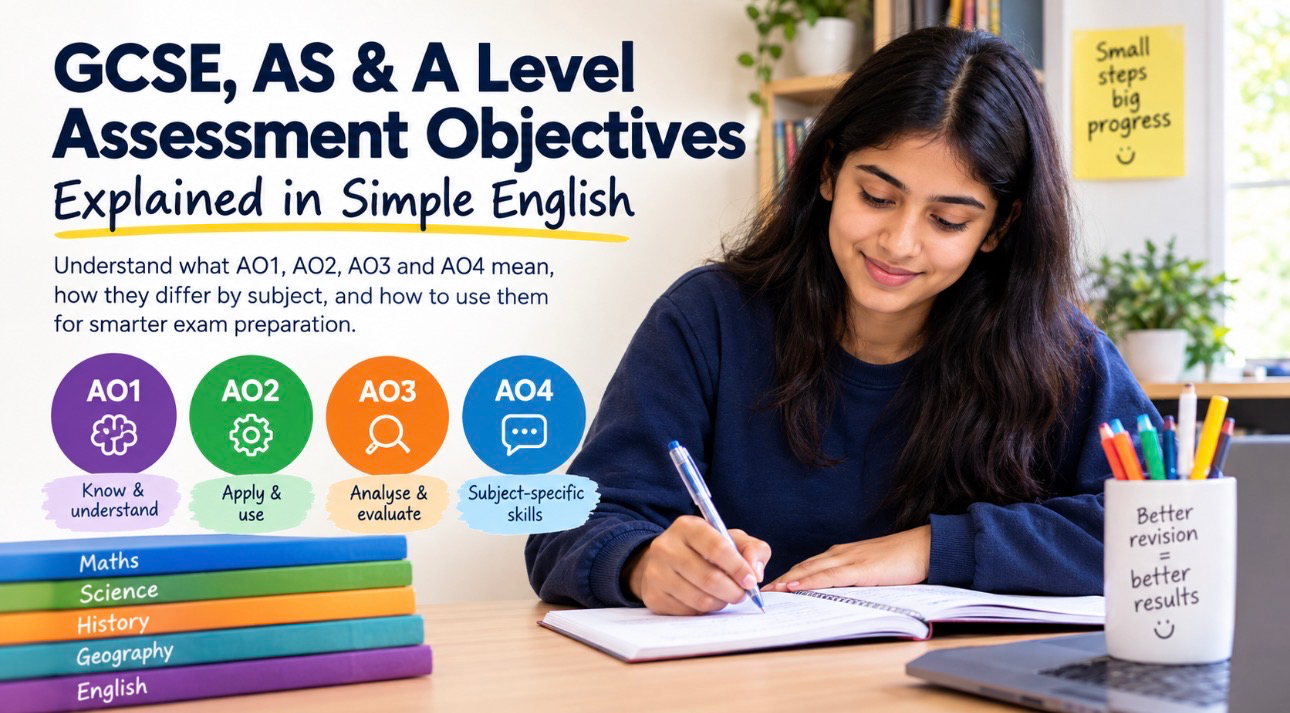
GCSE, AS and A Level Assessment Objectives Explained in Simple English
When students prepare for GCSE, AS or A Level exams, they usually start with the syllabus.
They make notes. They learn important topics. They practise questions. They revise again and again.
But there is one thing students sometimes miss:
What exactly does the examiner expect me to show in my answer?
Knowing the answer is one thing. Knowing how to use that knowledge in an examination is another.
This is where assessment objectives, often shortened to AOs, become useful.
Assessment objectives explain the types of knowledge and skills a qualification is designed to assess. They can help students understand why one answer receives more marks than another, why simply memorising notes is sometimes not enough, and why different subjects require different ways of preparing for an exam.
The official GOV.UK guidance covers assessment objectives for GCSE, AS and A Level qualifications across a wide range of subjects. The published guidance applies to qualifications in England and was updated on 31 March 2017. Official GOV.UK assessment objectives guidance
This article explains the idea in everyday English, with practical examples that students, parents and teachers can easily understand.
What Are Assessment Objectives?
Let’s make it simple.
An assessment objective tells you what the exam wants you to demonstrate.
It is not simply a list of topics you need to study.
It is about what you should be able to do with what you have learned.
For example, an exam might expect you to:
Remember important information
Explain a concept
Apply knowledge to a new situation
Analyse information
Compare different ideas
Interpret data
Solve a problem
Evaluate evidence
Give a reasoned opinion
Communicate clearly
The exact requirements depend on the subject.
A science exam may ask you to explain an experiment or interpret results.
A history exam may ask you to examine evidence and explain different interpretations.
A mathematics exam may ask you to solve an unfamiliar problem.
A language exam may test your listening, speaking, reading and writing.
So, there is no single assessment-objective formula that works for every subject.
Why Should Students Care About Assessment Objectives?
You may be thinking:
“I already have enough to study. Why should I worry about AOs?”
Because they can make your revision more useful.
Imagine you have spent three hours memorising everything about a topic.
Then the exam asks you to use that knowledge in a completely different situation.
You know the topic.
But you don’t know how to use it.
That can cost marks.
Assessment objectives help students understand that exams are often testing more than memory.
For example:
Remembering:
“I know what photosynthesis is.”
Understanding:
“I can explain how photosynthesis works.”
Applying:
“I can use that knowledge to explain what happens to a plant in a particular situation.”
Analysing:
“I can examine experimental results and explain what they show.”
Evaluating:
“I can consider the evidence and decide how strong the conclusion is.”
The exact terminology varies between subjects, but the basic idea is useful.
Assessment Objectives Are Different From Subject to Subject
This is important.
You should not assume that AO1 means exactly the same thing in every subject.
It doesn’t.
For example, in one subject AO1 may focus on knowledge.
In another, AO1 may refer to listening skills.
In mathematics, AO1 can involve using standard mathematical techniques.
So when you see AO1, AO2, AO3 or AO4, always check what those terms mean in your particular subject.
The official GOV.UK framework shows how different subjects use different assessment structures. GOV.UK assessment objectives
Subject-by-Subject AO Summary
The table below gives a quick overview of some common subjects. It is designed as a simple guide rather than a replacement for your official specification.
Subject
Assessment objective focus
What students are generally expected to demonstrate
Science
Knowledge, application, analysis and evaluation
Know scientific ideas, apply them to situations, and analyse or evaluate evidence and results
Mathematics
Techniques, reasoning and problem-solving
Use mathematical methods accurately, explain reasoning and solve problems
Geography
Knowledge, understanding, analysis/evaluation and geographical skills
Use geographical knowledge, analyse information, evaluate issues and use data, maps and fieldwork skills
History
Knowledge, historical analysis, sources and interpretations
Know historical content, analyse events, work with sources and understand different historical interpretations
Modern Foreign Languages
Listening, speaking, reading and writing
Understand and communicate in the target language across the four main language skills
Business
Knowledge, application, analysis and evaluation
Understand business ideas, apply them to situations and analyse or evaluate business decisions
Economics
Knowledge, application, analysis and evaluation
Understand economic concepts, apply them to situations, analyse information and evaluate arguments
Computer Science
Knowledge, application, computational thinking and evaluation
Understand computing concepts, apply them, solve computational problems and evaluate solutions
Psychology
Knowledge, application, analysis and evaluation
Understand psychological ideas and research, apply them and analyse or evaluate evidence
Sociology
Knowledge, application, analysis and evaluation
Understand sociological concepts, apply them to examples and analyse or evaluate different arguments
Important: The exact AO wording, percentages and structure can vary by qualification and examination board. The table should therefore be used as a quick starting point, not as a substitute for the current specification. GOV.UK assessment objectives
For example, GCSE modern foreign languages uses a very different AO structure from subjects such as science or business. GCSE geography also has a specific focus on geographical skills, while mathematics has its own structure around techniques, reasoning and problem-solving.
A Simple Way to Understand AOs
Although every subject is different, students can think about assessment in four broad stages.
1. Know It
You need basic knowledge.
Can you remember the important information?
Can you explain the key ideas?
2. Use It
Can you use your knowledge when the question gives you a particular situation?
3. Think About It
Can you analyse information, compare ideas, identify relationships or explain why something happened?
4. Make a Judgement
Can you look at the evidence, consider different possibilities and reach a sensible conclusion?
Not every subject uses these four stages in exactly this way.
But this simple model can help students understand why examination questions can become more demanding.
GCSE Assessment Objectives
At GCSE level, assessment objectives depend heavily on the subject.
The official framework covers subjects including science, geography, history, mathematics, business, economics, computer science, psychology, sociology and modern foreign languages, among others. GOV.UK GCSE, AS and A Level assessment objectives
Let’s look at some examples.
Science: Knowing Is Only the Beginning
Science is a good example because students often spend a lot of time memorising facts.
At GCSE, the assessment framework broadly covers:
Scientific knowledge and understanding
Applying scientific knowledge
Analysing and evaluating information and evidence
The published GCSE framework gives 40% to knowledge and understanding, 40% to application and 20% to analysis and evaluation. GOV.UK science assessment objectives
Think about a biology student studying enzymes.
Knowing the definition of an enzyme is useful.
But an exam may then ask you to:
Explain what happens when temperature changes
Interpret experimental results
Suggest why an experiment produced a particular result
Evaluate the reliability of the experiment
That requires more than memory.
How to revise science
Don’t just read your notes.
Try this instead:
Learn → explain → apply → practise → check
After learning a topic, close your book and explain it in your own words.
Then try questions you have not seen before.
That is where you start building examination skills.
Mathematics: Getting the Answer Is Not Always Enough
Mathematics has its own assessment structure.
At AS and A Level, the framework covers standard mathematical techniques, mathematical reasoning and problem-solving. GOV.UK mathematics assessment objectives
This means students need to do more than memorise formulas.
They need to know:
Which method should I use?
Why does this method work?
Can I solve the problem if it looks different from the example I practised?
At AS level, the published framework gives 60% to standard techniques, 20% to reasoning and 20% to problem-solving.
At A Level, the balance changes to 50% standard techniques, 25% reasoning and 25% problem-solving. GOV.UK mathematics assessment objectives
This is one reason students should practise unfamiliar problems, not just repeat questions that look exactly like their classroom examples.
Geography: More Than Learning Case Studies
Many geography students spend a lot of time learning case studies.
That is important.
But case-study knowledge is only part of the subject.
The GCSE geography framework includes:
Geographical knowledge
Understanding geographical ideas
Analysis and evaluation
Geographical skills
The published framework gives 15% to AO1, 25% to AO2, 25% to AO3 and 25% to AO4. GOV.UK geography assessment objectives
So a student may need to know a case study and then use it to answer a question about a wider geographical issue.
They may also need to:
Read a map
Interpret a graph
Analyse data
Explain patterns
Evaluate an issue
Use fieldwork evidence
Reach a conclusion
At AS and A Level, geography also places significant emphasis on geographical skills, including quantitative, qualitative and fieldwork skills. GOV.UK geography assessment objectives
So don’t revise geography as if it were simply a list of facts.
History: Facts Plus Evidence and Interpretation
History is another subject where memorising information is only part of the job.
Students need to know what happened.
But they may also need to explain:
Why something happened
What evidence tells us
How useful or relevant a source is
Why historians may interpret an event differently
Which explanation is better supported
The GCSE framework includes knowledge and understanding, historical analysis, source work and analysis of historical interpretations. GOV.UK history assessment objectives
This means a good history revision session should involve more than learning dates.
Try asking:
What happened?
Why did it happen?
What evidence supports this?
Could there be another explanation?
How convincing is this interpretation?
Those questions help develop the kind of thinking history assessments require.
Modern Foreign Languages: You Have to Use the Language
Learning a language is different from learning a subject where most of the assessment is written.
At GCSE, the published framework divides modern foreign language assessment equally between:
Listening
Speaking
Reading
Writing
Each area represents 25% of the assessment framework. GOV.UK modern foreign languages assessment objectives
That tells students something very practical.
Don’t spend all your revision time reading vocabulary lists.
You need to use the language.
Listen to it.
Speak it.
Read it.
Write it.
At AS and A Level, students also need to demonstrate understanding of spoken and written language, accurate language use and knowledge of the culture and society connected with the language. GOV.UK modern foreign languages assessment objectives
Business and Economics: Apply Your Knowledge to the Situation
Business and economics questions often give students a particular situation.
That situation matters.
Suppose a question describes a company that is losing customers.
You may know several business theories that could be relevant.
But the examiner wants you to connect the theory to the company described in the question.
That is application.
The published GCSE framework gives business and economics a 35% weighting for knowledge, 35% for application and 30% for analysis and evaluation. GOV.UK business and economics assessment objectives
So instead of writing a generic answer, ask:
“How does this idea apply to the situation in the question?”
That one habit can make answers much more focused.
Computer Science: Understand the Idea and Use It
Computer science combines knowledge with practical thinking.
The GCSE framework covers knowledge and understanding, application, and computational analysis, design, programming, evaluation and refinement. GOV.UK computer science assessment objectives
So reading programming notes is not enough.
Students need to practise solving problems.
For example:
What should the program do?
How can I break the problem into smaller parts?
Which algorithm could work?
How can I test my solution?
What happens if the input changes?
That type of practice helps turn theoretical knowledge into usable skill.
Psychology and Sociology: Knowledge, Application and Evaluation
Subjects such as psychology and sociology also combine knowledge with application and evaluation.
For GCSE psychology, the published framework gives 35% to knowledge and understanding, 35% to application, and 30% to analysis and evaluation. GOV.UK psychology assessment objectives
Sociology uses a 40% knowledge, 40% application and 20% analysis/evaluation structure at GCSE. GOV.UK sociology assessment objectives
This means students should learn theories and research, but also practise applying them to examples and building arguments.
What Is the Difference Between GCSE and A Level Assessment?
A Level is not simply GCSE with more chapters.
As students move to AS and A Level, they generally encounter:
More detailed subject content
Greater depth
More independent study
More demanding application
More analysis
More evaluation
More subject-specific reasoning
The exact change depends on the subject.
For example, the published mathematics framework increases the weighting given to reasoning and problem-solving from AS to A Level. Science also gives a greater proportion of the assessment to analysis and evaluation at A Level than at GCSE. GOV.UK assessment objectives
So students moving into A Level should expect not only to learn more, but also to think more deeply about what they learn.
What Do AO1, AO2, AO3 and AO4 Actually Mean?
Students often search for simple definitions such as:
AO1 = knowledge
AO2 = application
AO3 = analysis
AO4 = evaluation
That can be useful as a rough idea, but it is not always correct.
The meaning changes from subject to subject.
For example, in GCSE modern foreign languages:
AO1 = Listening
AO2 = Speaking
AO3 = Reading
AO4 = Writing
In GCSE geography, the four objectives are structured differently.
In mathematics, the objectives have another meaning again. GOV.UK assessment objectives
The safest rule is simple: always read the assessment objectives for your own subject.
How Students Can Use Assessment Objectives for Revision
You don’t need to make revision complicated.
Start with your subject specification.
Find the assessment objectives.
Then ask yourself:
Do I know the content?
Can I explain the important topics without looking at my notes?
Can I use the knowledge?
Can I answer a question where the situation is different from the example in my textbook?
Can I analyse?
Can I explain relationships, causes, effects, patterns or evidence?
Can I evaluate?
Can I compare ideas and explain which argument is better supported?
Can I use the subject skills?
Can I interpret graphs, analyse sources, solve problems, conduct calculations, write in another language or use practical skills, depending on the subject?
This creates a much better revision plan than simply saying:
“I need to revise everything.”
Use Past Papers Differently
Past papers are one of the best ways to understand assessment.
But many students use them only at the end of revision.
Try using them earlier.
Take a question and ask:
What is this question really testing?
Is it asking you to:
Recall?
Explain?
Apply?
Analyse?
Evaluate?
Calculate?
Interpret?
Compare?
Then attempt the question.
Afterward, read the mark scheme carefully.
Don’t only look at the final answer.
Look at why the marks were awarded.
That can teach you more about examination technique than simply reading another page of notes.
Don’t Write Everything You Know
One common mistake is writing everything you remember about a topic.
That can feel productive.
But an examination answer should be focused on the question.
Suppose the question asks:
“Explain one reason why the business may experience falling sales.”
You don’t need to write everything you know about the business.
You need to:
Identify a relevant reason.
Explain it.
Connect it to the situation.
Develop the answer where appropriate.
The goal is not to show the examiner how much of the textbook you remember.
The goal is to show that you can answer the question.
Understanding Command Words
Examination questions often use words such as:
Describe
Explain
Analyse
Compare
Assess
Evaluate
Discuss
Justify
These words matter.
Describe generally asks you to say what something is like.
Explain usually requires you to give reasons or show how something works.
Analyse requires you to examine relationships, causes, effects or other connections.
Compare requires you to identify similarities and differences.
Evaluate normally requires you to consider evidence or different sides before reaching a supported judgement.
However, students should always check how their particular examination board uses these terms.
Do not assume that one simple definition applies to every subject.
Why Students Sometimes Lose Marks Even When They Know the Topic
This happens more often than many students realise.
A student may have excellent notes.
They may know every definition.
They may even be able to explain the topic to a friend.
But the exam question may require something different.
For example, the student may need to:
Apply the concept to a new situation
Explain a cause and its consequence
Interpret a graph
Evaluate evidence
Compare two arguments
Reach a justified conclusion
This is why examination preparation should include doing, not just reading.
A Better Revision Method
Try this simple approach:
Learn
Study the topic and understand the key ideas.
Close the Book
Try to explain what you have learned without looking.
Apply
Answer an unfamiliar question.
Check
Use the mark scheme or teacher feedback.
Improve
Rewrite the weak part of your answer.
Repeat
Practise the same skill again later.
This is much closer to what happens in an actual examination.
What Teachers Can Do With Assessment Objectives
Assessment objectives are also useful for teachers.
A teacher can use them when planning lessons, homework and classroom tests.
For example, one lesson may focus on understanding a concept.
The next may ask students to apply it.
Another may involve analysing information.
Later, students may practise writing an evaluation.
This allows examination skills to develop gradually rather than leaving them until the final few weeks before exams.
It also helps teachers identify whether a student has a knowledge problem or a skills problem.
A student might know the content but struggle to apply it.
Another student might apply ideas well but have gaps in basic knowledge.
Those students need different kinds of support.
What Parents Should Understand
Parents do not need to become examination experts.
But understanding assessment objectives can make conversations about study more useful.
Instead of asking:
“Did you study today?”
try asking:
“What did you learn?”
“Can you explain it without your book?”
“Did you practise any questions?”
“What type of questions do you find difficult?”
“What did you learn from your last test?”
These questions can help students think about their progress rather than simply counting study hours.
A Simple Assessment Objective Checklist
Before an exam, students can work through this list.
Knowledge
□ I know the important facts and concepts.
□ I understand the key terms.
□ I can explain the main topics in my own words.
Application
□ I can use what I know in a new situation.
□ I can connect ideas to examples.
□ I can use information provided in a question.
Analysis
□ I can explain relationships.
□ I can identify causes and effects where relevant.
□ I can interpret information or evidence.
Evaluation
□ I can consider different viewpoints.
□ I can discuss strengths and weaknesses.
□ I can support my judgement with evidence.
Examination Skills
□ I understand the command words.
□ I answer the question directly.
□ I use appropriate subject terminology.
□ I manage my time.
□ I check my work when possible.
A Note for Students Studying International Qualifications
This point is particularly important for students in international schools.
The GOV.UK document is an official source for the assessment-objective framework described there, but it is specifically associated with qualifications in England. The page was last updated on 31 March 2017. GOV.UK official guidance
If you are studying:
Cambridge International qualifications
Pearson qualifications
OxfordAQA qualifications
Another international examination board
you should check the current specification and assessment objectives for your exact qualification.
Do not copy a percentage or assessment structure from another board and assume it applies to your examination.
The general lesson is still valuable:
Know what you are being assessed on, not just what you are expected to study.
Assessment Objectives and Better Learning
There is a bigger lesson behind all of this.
Good education is not simply about remembering information for an examination.
Students need to learn how to use information.
They need to ask questions.
They need to understand evidence.
They need to solve problems.
They need to explain their thinking.
They need to make decisions based on information.
Assessment objectives are one way of putting those skills into a clear examination framework.
That is why understanding them can help students beyond a single exam.
Frequently Asked Questions
What are assessment objectives?
Assessment objectives describe the knowledge and skills that a qualification is designed to assess.
What does AO mean?
AO means Assessment Objective.
Is AO1 always knowledge?
No. The meaning of AO1 depends on the subject.
Is AO2 always application?
No. AO2 has different meanings in different subjects.
What does AO3 usually involve?
In many subjects, AO3 involves analysis, evaluation or problem-solving, but students should check the exact definition for their qualification.
What is AO4?
AO4 is used in some subjects for additional subject-specific skills. For example, GCSE modern foreign languages uses AO4 for writing. GOV.UK assessment objectives
Why are assessment objectives important?
They help students understand what they need to demonstrate in an examination and can make revision more focused.
Do assessment objectives tell me what questions will appear?
No. They describe what the qualification assesses. They do not tell you the exact questions that will appear.
Are GCSE and A Level assessment objectives the same?
No. They can differ by subject and qualification level.
Can I use the GOV.UK assessment objectives for Cambridge International exams?
You should not assume that the GOV.UK framework applies directly to Cambridge International examinations. Check the current Cambridge syllabus and assessment objectives for your particular subject.
Final Thoughts
Assessment objectives may sound like complicated examination language.
The basic idea is actually quite simple.
Exams do not only ask what you know. They also ask what you can do with what you know.
You may need to remember information.
You may need to apply it.
You may need to analyse it.
You may need to evaluate evidence.
You may need to solve a problem.
Or you may need to communicate your ideas in a particular way.
The exact requirements depend on your subject and examination board.
So, when preparing for GCSE, AS or A Level, don’t stop at:
“I have finished the chapter.”
Ask yourself:
“Can I actually use what I learned?”
Can you answer an unfamiliar question?
Can you explain your reasoning?
Can you analyse evidence?
Can you support your conclusion?
Can you use the subject-specific skills your examination requires?
That is where assessment objectives become useful.
They give students a clearer picture of what sits behind the marks—and they can help turn revision from simply reading more into learning how to perform better in the actual assessment.
Important: Always use the current specification and assessment objectives published by your own examination board. The GOV.UK guidance discussed in this article is an England-specific framework and should not be treated as a universal assessment system for every GCSE, AS, A Level or international qualification.