
Online Continuous Assessment System in Nepal \| CAS Nepal
16 September 2026
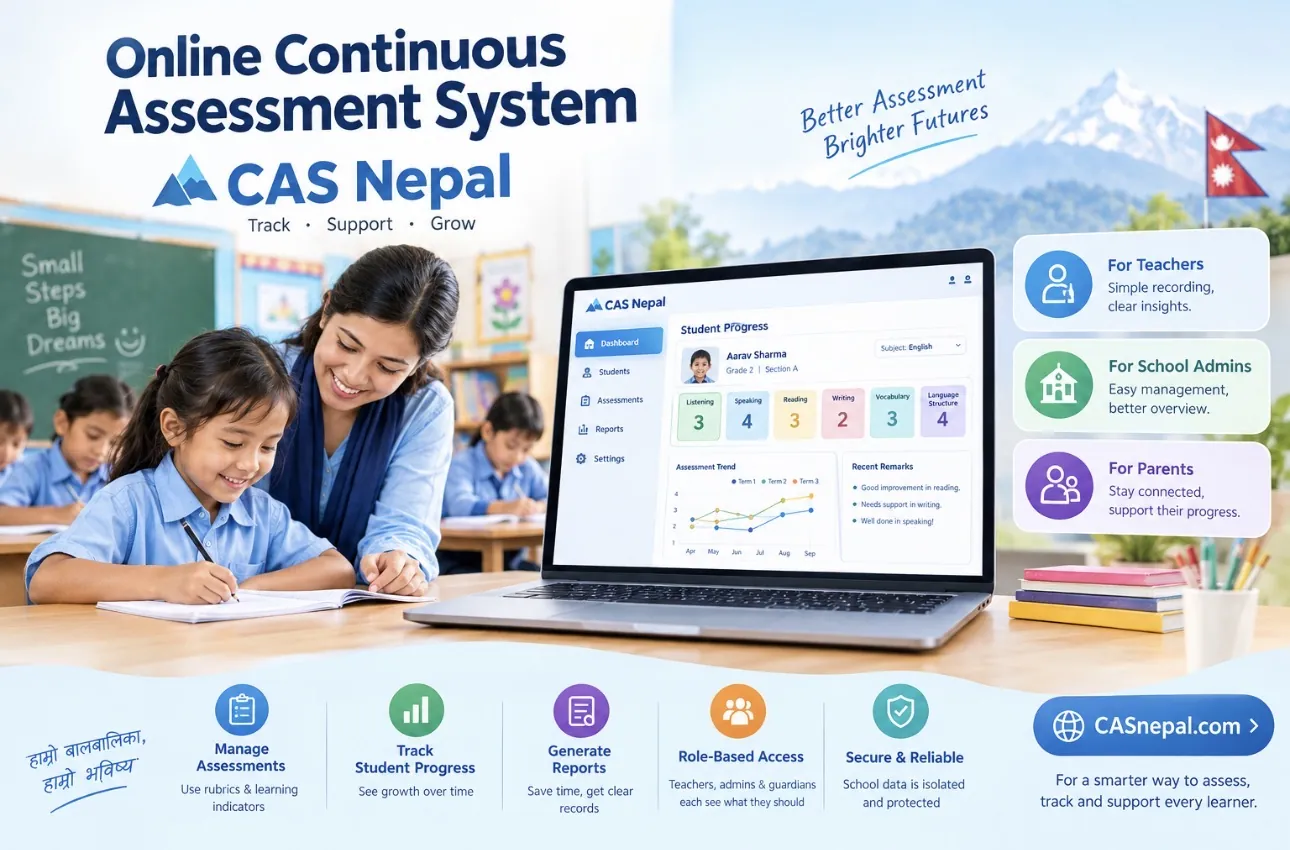
Online Continuous Assessment System – CAS Nepal
Assessment is an important part of every school. But assessment does not always have to mean a written exam at the end of a term.
For young children, teachers need to see how students are learning every day. They need to observe classroom activities, check skills, record progress, give feedback, and provide extra support when a child needs it.
This is where a Continuous Assessment System (CAS) becomes useful.
In Nepal, continuous assessment has been part of the discussion and practice of school education for many years. Research and educational discussions have also highlighted the importance of using classroom-based assessment to understand student learning rather than depending only on final examinations.
However, managing CAS on paper can be difficult.
Teachers may have many forms to complete, student records can become scattered, and calculating progress manually takes time.
An online continuous assessment system can make this work more organised.
One example designed specifically for Nepali primary schools is CAS Nepal, available at CASnepal.com. It focuses on continuous assessment for Grades 1–5 and provides tools for teachers, school administrators, and guardians.
What is an Online Continuous Assessment System?
An online continuous assessment system is a digital platform that helps schools record, manage, and understand student learning throughout the academic year.
Instead of keeping assessment information in separate notebooks, spreadsheets, or printed forms, teachers can record assessment information online.
A typical online CAS may help teachers:
Record student assessments
Use learning indicators or competencies
Apply rubrics
Record observations
Add remarks
Record remedial assessments
Track student progress
Prepare assessment reports
Keep cumulative records
Share appropriate information with parents or guardians
The main idea is simple: assessment becomes part of everyday teaching instead of becoming a separate task at the end of the term.
Why Do Schools Need Online CAS?
Managing continuous assessment manually can become difficult when a teacher has many students.
Imagine a teacher responsible for 30 or 40 students. The teacher may need to record different learning indicators, subjects, themes, assessment dates, observations, evidence, and remarks.
Doing all of this on paper takes time.
There is also the risk of:
Lost records
Calculation mistakes
Repeated data entry
Difficult report preparation
Missing assessment evidence
Difficulty checking previous progress
An online system keeps information in one organised place.
For school administrators, this can make it easier to understand what is happening across classes and sections. For teachers, it can reduce repetitive record-keeping. For guardians, it can provide a clearer picture of a child’s progress.
How Does CAS Nepal Work?
CAS Nepal is designed around the needs of primary schools in Nepal.
According to its platform information, it supports Grades 1–5 and uses rubric-based assessment, competency tracking, cumulative assessment records, and role-based access for school administrators, teachers, and guardians.
The basic workflow is straightforward.
1. School sets up its academic structure
The school can organise grades, sections, subjects, themes, and learning indicators.
This creates the foundation for assessment.
2. Teachers assess students
Teachers can record assessment results against learning indicators.
Instead of simply entering a final number, the assessment can be connected to what the student is expected to learn.
3. Evidence and remarks can be recorded
A teacher may need to remember why a particular assessment was given.
Observations, remarks, dates, assessment methods, and evidence can help create a clearer record of the student’s learning.
4. Progress can be calculated
Digital systems can handle calculations that would otherwise have to be done manually.
CAS Nepal describes a 1–4 rating structure and a process where remedial assessment can replace the earlier score when a remedial assessment exists.
5. Reports can be prepared
Assessment information can then be used to prepare cumulative records and reports.
This can save teachers and school administrators considerable administrative work.
What Is Rubric-Based Assessment?
A rubric gives teachers a simple structure for judging student performance.
For example, a school may use a four-level scale:
1 – Below Basic
2 – Basic
3 – Proficient
4 – Advanced
The exact indicators and categories can vary according to the school’s assessment structure.
The benefit of a rubric is consistency.
Instead of asking only, “What mark should I give this student?”, the teacher can ask:
“What can this student currently do?”
That creates a more meaningful picture of learning.
CAS Nepal states that its assessment structure uses learning indicators and a 1–4 rating scale, with assessment information recorded against subjects and themes.
Online CAS for Grades 1–5
Primary education requires a different approach to assessment than higher grades.
Young children are developing many skills at the same time.
A teacher may need to observe:
Reading
Writing
Speaking
Listening
Vocabulary
Language use
Participation
Classroom activities
Practical work
Social and learning behaviours
A continuous assessment system allows these observations to become part of the student’s record.
This is particularly useful when the school wants to look at progress over time rather than only at one examination.
Recent discussion in Nepal has also focused on alternative assessment approaches for primary students, including the role that continuous assessment can play as schools move away from traditional examination-focused approaches.
Benefits for Teachers
An online continuous assessment system can reduce some of the routine work involved in maintaining assessment records.
Teachers can have assessment information in one place rather than searching through multiple files.
Some practical benefits include:
Less paperwork: Digital records reduce dependence on printed assessment sheets.
Better organisation: Student information, indicators, scores, remarks, and evidence can be connected.
Faster reporting: Digital calculations and report generation can reduce manual work.
Easier progress tracking: Teachers can look back at previous assessments.
Better follow-up: Students who need additional support can be identified and assessed again.
The technology should not replace the teacher’s judgment. The teacher still observes the student and makes the professional assessment. The software simply helps organise the information.
Benefits for School Administrators
School administrators also need a clear view of assessment.
An online CAS can help administrators manage:
Students
Teachers
Classes
Sections
Subjects
Assessment structures
Reports
School records
This becomes especially useful when a school has several sections or many teachers.
CAS Nepal provides role-based access so that administrators, teachers, and guardians have different levels of access to information.
Benefits for Parents and Guardians
Parents often receive information about their child’s learning only when a report card is issued.
But learning happens throughout the year.
A digital assessment system can help create a better connection between school and home.
Instead of seeing only a final result, guardians can have access to appropriate information about their child’s learning progress.
CAS Nepal describes a guardian role that allows guardians to follow the progress of their linked child.
This can help parents have more useful conversations with teachers.
Is an Online CAS the Same as a School Management System?
No.
A school management system may cover many areas such as fees, transport, attendance, admissions, payroll, examinations, and administration.
An online continuous assessment system has a more specific purpose.
Its main focus is student learning and assessment over time.
CAS Nepal is positioned specifically around continuous assessment for primary schools rather than as a general-purpose school ERP.
Why Choose a Nepal-Focused CAS?
Every education system has its own requirements.
A system built for another country may not match the terminology, assessment structure, academic calendar, or reporting practices used by Nepali schools.
CAS Nepal is built specifically for Nepali primary schools and supports Bikram Sambat dates alongside assessment and reporting workflows.
The platform also states that schools are onboarded individually and that school data is isolated between organisations.
For schools, this matters because digital assessment should fit their actual workflow rather than forcing teachers to completely change how they work.
What Should Schools Look for in an Online CAS?
Before selecting an online continuous assessment system, schools should consider a few important questions.
Does it support the required grades?
For primary schools, check whether the system supports the grades and subjects used by the school.
Can teachers use rubrics?
Rubrics should be easy to understand and practical for classroom use.
Can schools manage their own structure?
Schools may have different sections, subjects, themes, and internal workflows.
Can remedial assessment be recorded?
Additional support and follow-up assessment can be an important part of continuous assessment.
Can reports be generated?
A digital system should make reporting easier rather than creating another administrative burden.
Is student data protected?
Student information is sensitive. Schools should understand how data is stored, who can access it, and how access is controlled.
CAS Nepal’s published privacy policy states that school data is isolated by organisation and that access is restricted according to user roles.
Online Continuous Assessment System in Nepal
The move from paper-based assessment to digital assessment does not mean changing the purpose of CAS.
The purpose remains the same: understand student learning, record evidence, provide feedback, identify areas where support is needed, and follow progress.
The difference is how the information is managed.
With an online CAS, teachers can spend less time searching through records and more time using assessment information to support students.
For Nepali schools looking for a digital solution, CAS Nepal provides an online platform focused on continuous assessment for primary Grades 1–5.
Schools can learn more about the platform and request access through CASnepal.com.
Frequently Asked Questions
1. What is an online continuous assessment system?
An online continuous assessment system is digital software that helps schools record, manage, track, and report student learning throughout the academic year.
2. What is CAS in Nepal?
CAS stands for Continuous Assessment System. It focuses on monitoring student learning continuously through classroom activities, observations, learning indicators, evidence, feedback, and assessment records.
3. What is CAS Nepal?
CAS Nepal is an online continuous assessment platform designed for primary schools in Nepal, with a focus on Grades 1–5.
4. Can teachers use CAS Nepal for rubric-based assessment?
Yes. CAS Nepal describes a rubric-based assessment structure using learning indicators and a 1–4 rating scale.
5. Can parents see their child’s progress?
CAS Nepal provides guardian accounts designed to allow guardians to follow the progress of their linked child.
6. Can schools use an online CAS for Grades 1–5?
Yes. CAS Nepal is specifically positioned for primary schools running Grades 1–5.
7. Does online CAS replace teachers?
No. Technology manages records and calculations, but teachers remain responsible for observing students, assessing learning, providing feedback, and making professional judgments.
8. Can remedial assessment be recorded?
A CAS platform can support remedial assessment as part of the student’s learning record. CAS Nepal describes remedial assessment as a second assessment after support, with the remedial score replacing the regular score when it exists.
9. Is CAS only about giving marks?
No. Continuous assessment is about understanding learning over time. Marks or ratings are only one part of the overall assessment record.
10. Where can schools learn about an online CAS in Nepal?
Schools can visit CASnepal.com to learn about the CAS Nepal platform, its assessment features, access process, and solutions for schools.
Final Thoughts
Continuous assessment works best when it becomes part of normal classroom practice.
Teachers observe. Students learn. Teachers record evidence. Students receive feedback. Additional support is provided when needed. Progress is then recorded over time.
An online continuous assessment system can make this process easier to manage.
For Nepal’s primary schools, the important thing is not simply moving paper forms onto a computer. The technology should support the actual purpose of assessment: understanding each child’s learning and helping that child improve.
That is the idea behind CAS Nepal — bringing continuous assessment, student progress records, teacher workflows, reports, and guardian visibility into one digital platform for primary schools in Nepal.
Learn more about the Online Continuous Assessment System at CASnepal.com.