
A practical guide to continuous assessment in Grades 1–5
31 August 2026
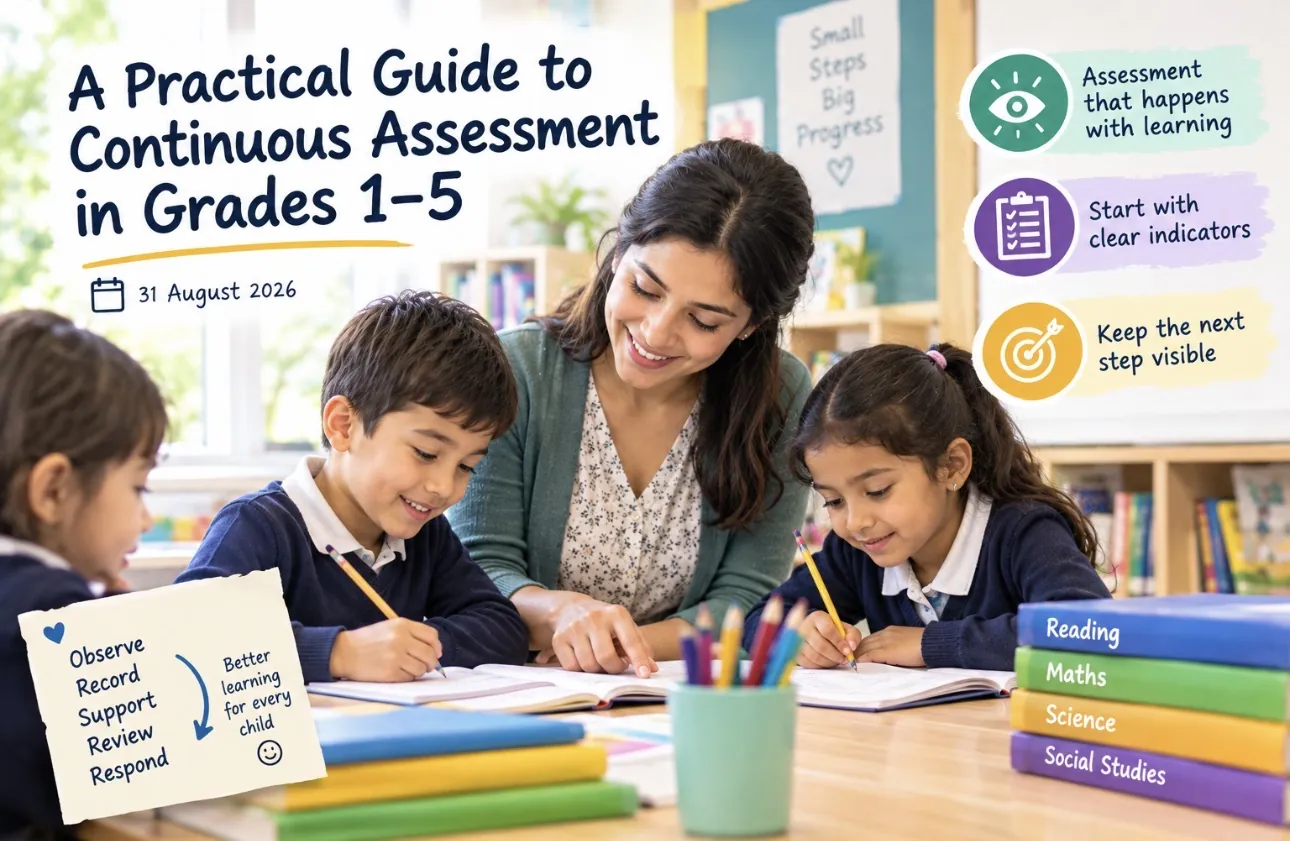
A Practical Guide to Continuous Assessment in Grades 1–5
Assessment is often associated with tests, marks, report cards, and the end of a term. But for young children, learning does not happen only when they sit down for a test.
Children learn while they are reading a story, solving a maths problem, answering a question, working with a classmate, drawing a picture, explaining an idea, or trying something for the first time.
That is why continuous assessment in Grades 1–5 can be so valuable.
Continuous assessment means paying attention to learning as it happens. Instead of waiting until the end of a unit or term to find out what a child understands, teachers regularly notice, record, and respond to evidence from everyday classroom activities.
The goal is not to give children more tests.
The goal is to understand their learning better.
When done well, continuous assessment becomes part of the normal classroom rhythm. It helps teachers see what children can already do, where they need support, and what the next step in their learning should be.
What is continuous assessment?
Continuous assessment is an ongoing process of observing and recording student learning over time.
It can happen during normal classroom activities rather than through separate assessment sessions.
For example, a Grade 2 teacher may ask students to read a short paragraph aloud. While listening, the teacher notices that one child can recognise most words but needs help with fluency.
That is assessment.
A Grade 3 teacher may ask students to explain how they solved a maths problem. One student reaches the correct answer but struggles to explain the steps.
That is assessment too.
A Grade 5 teacher may observe students working together on a science project and notice that a student has strong ideas but needs support when presenting them to the group.
Again, that is useful assessment evidence.
These small observations can tell teachers a great deal when they are recorded and used consistently.
Assessment should happen with learning
The strongest approach to assessment in primary education is often one that fits naturally into teaching.
Teachers do not need to stop a lesson every time they want to assess something.
Instead, they can look for evidence during activities that are already taking place.
A teacher might:
Ask questions during a lesson.
Listen to students explain their thinking.
Review classwork.
Watch students solve problems.
Observe group activities.
Check reading fluency.
Look at writing samples.
Review project work.
Give short practice activities.
Notice how independently a child completes a task.
These activities provide opportunities to understand learning without making assessment feel like a separate event.
This is especially important for children in Grades 1–5. Young learners can sometimes find formal tests stressful or unfamiliar. Everyday classroom evidence can give teachers a broader picture of what a child knows and can do.
Start with clear indicators
One of the first steps in creating an effective continuous assessment system is deciding what teachers should look for.
This is where simple competency indicators can help.
A competency indicator describes a skill or behaviour that a teacher can observe.
For example, instead of using a broad statement such as “Good at reading,” a teacher might look for specific indicators such as:
Reads familiar words with increasing accuracy.
Can retell the main idea of a short text.
Uses context to understand unfamiliar words.
Answers questions about a story.
Reads aloud with improving fluency.
These indicators give teachers a clearer picture of what learning looks like.
They also create a shared language across the school.
When teachers use similar indicators, it becomes easier to discuss student progress and understand what different levels of development mean.
Why rubrics can help
A rubric for primary education can make these expectations even clearer.
A rubric provides descriptions of what different stages of performance may look like.
For example, a writing rubric for younger students might include areas such as:
Communicating an idea.
Organising thoughts.
Using appropriate vocabulary.
Forming sentences.
Checking and improving work.
The language should be simple enough for teachers to use easily and, where appropriate, for children to understand.
A rubric should not become a complicated document that takes more time to complete than the actual learning activity.
Its purpose is to make expectations visible.
When teachers know what they are looking for, observations become more focused. Instead of simply recording that a child completed a task, the teacher can record what the child demonstrated during that task.
Keep the evidence simple
One common mistake with continuous assessment is trying to record everything.
Teachers already have busy classrooms. If every observation requires a long written note, the system quickly becomes difficult to maintain.
A better approach is to capture useful evidence without creating unnecessary paperwork.
For example, a teacher might record:
Skill: Explains a maths strategy.
Evidence: Student explained how they used addition to check subtraction.
Next step: Encourage the student to explain why the strategy works.
This short record may be more useful than a long paragraph.
The important question is not, “How much can we record?”
The better question is, “What evidence will help us understand and support this child’s learning?”
Look beyond the score
A score can be useful, but a score alone does not tell the whole story.
Imagine a student receives 3 out of 5 for a particular competency.
What does that actually mean?
Can the child perform the skill with support?
Can they do it independently?
Have they improved since the last observation?
What part of the skill is still difficult?
What should the teacher do next?
This is why the most useful student assessment records go beyond scores.
A good record can include three simple elements:
What can the child do?
What is the next step?
What support might help?
These questions turn assessment into something that can guide teaching rather than simply describe past performance.
Keep the next step visible
The next step in learning is one of the most important parts of continuous assessment.
Assessment should help answer the question, “What do we do now?”
For example, a Grade 1 child may recognise individual letters but struggle to blend them into words.
The next step might be regular practice with simple sound combinations.
A Grade 3 student may understand multiplication but make mistakes when solving word problems.
The next step might be helping the child identify the important information in a problem before choosing an operation.
A Grade 5 student may have strong written ideas but struggle to organise a longer piece of writing.
The next step could be planning ideas using headings or a simple writing structure.
In each case, assessment leads naturally into teaching.
That is the real purpose of continuous assessment.
Record when you will look again
Another useful habit is to record when the teacher plans to review the skill again.
This does not need to be complicated.
It could simply say:
Review next week.
Check during the next reading activity.
Revisit after two practice sessions.
Observe during the next group project.
This creates a simple cycle:
Observe → Record → Support → Review → Respond
The cycle can then continue throughout the year.
This approach makes assessment active rather than something that sits in a file and is only opened when reports are due.
Continuous assessment supports differentiated teaching
Children in the same grade do not all learn at the same speed.
One child may understand a concept quickly, while another may need more examples and practice.
This is normal.
Continuous assessment in Grades 1–5 can help teachers notice these differences earlier.
If a teacher regularly collects small pieces of evidence, they can identify students who may need additional support before a difficulty becomes a bigger problem.
At the same time, teachers can also identify students who are ready for greater challenge.
This makes it easier to plan differentiated learning.
For example, during a maths lesson, a teacher might notice that:
Some students still need concrete examples.
Some students can solve the problem independently.
A few students are ready to explain different methods.
The teacher can then adjust the next activity accordingly.
Assessment has become part of lesson planning.
Make assessment useful for children too
Continuous assessment should not only help teachers.
It can also help children understand their own learning.
Young students benefit from simple feedback.
Instead of saying:
“You got 7 out of 10.”
A teacher might say:
“You can explain the main idea. Now let’s practise finding two details from the story that support it.”
This tells the child what they have achieved and what they can work on next.
As children become older, teachers can involve them more directly.
Students can reflect on questions such as:
What can I do now?
What was difficult?
What helped me?
What do I want to improve?
What will I try next?
This encourages children to become more aware of their own learning.
Keep assessment manageable for teachers
A successful continuous assessment system must work in a real classroom.
If it creates too much administrative work, teachers may struggle to use it consistently.
Schools should therefore keep the process practical.
A simple system might include:
Clear competencies that teachers understand.
Simple indicators that can be observed.
Short evidence notes rather than lengthy descriptions.
A clear next step for the student.
A review point so progress can be checked later.
Technology can help organise these records, but technology should support the teacher rather than create another layer of work.
The teacher remains the person who understands the child and interprets the evidence.
Continuous assessment is not about testing more
It is important to remember that continuous assessment does not mean giving children more examinations.
In fact, it can mean relying less on single high-pressure moments.
A child may have a difficult day during a formal test.
They may be tired, nervous, distracted, or simply unable to show what they know in that particular format.
Ongoing evidence gives teachers more opportunities to see learning in different situations.
Over time, several small pieces of evidence can provide a much clearer picture than one isolated score.
A practical classroom example
Consider a Grade 4 classroom where students are learning how to write persuasive paragraphs.
The teacher introduces the skill and gives students a short writing activity.
While students work, the teacher observes that most students can state an opinion. However, some students provide reasons without explaining them.
The teacher records this observation using a simple rubric.
The evidence shows:
Current skill: Student can state an opinion and provide a reason.
Area to develop: Explain why the reason supports the opinion.
Next step: Model how to add an explanation after each reason.
Review: Look at the next writing activity.
The following week, the teacher checks the students’ writing again.
Some students have improved. Others still need support.
The teacher now has evidence that can guide the next lesson.
Nothing extra or complicated was required. Assessment happened while learning was taking place.
The goal is better decisions, not more data
Schools sometimes assume that collecting more information automatically leads to better assessment.
It does not.
Too much information can make it harder to see what matters.
The real value of continuous assessment comes from collecting the right evidence and using it to make better decisions.
Teachers need to know:
What has the child learned?
What evidence shows this?
What is still difficult?
What support is appropriate?
What should happen next?
When should progress be reviewed?
If the assessment process helps answer these questions, it is doing its job.
Conclusion
Continuous assessment in Grades 1–5 works best when it becomes part of everyday teaching rather than a separate event at the end of a term.
Teachers can observe children during normal classroom activities, record simple evidence, and use clear competency indicators to understand progress.
A rubric can provide a shared language and make expectations visible, while short evidence records can help teachers avoid unnecessary paperwork.
Most importantly, assessment should always keep the next step visible.
A useful record does more than show what a child scored. It helps explain what the child can do, what they need to work on, what support may help, and when the teacher should look again.
When assessment follows this simple cycle, it becomes much more than a way of measuring learning.
It becomes part of learning itself.
The best continuous assessment is not about testing children more often. It is about noticing learning more carefully, responding at the right time, and helping every child take their next step with confidence.