
Primary Students Are Moving Away From Exams: Can Continuous Assessment Fill the Gap?
11 September 2026
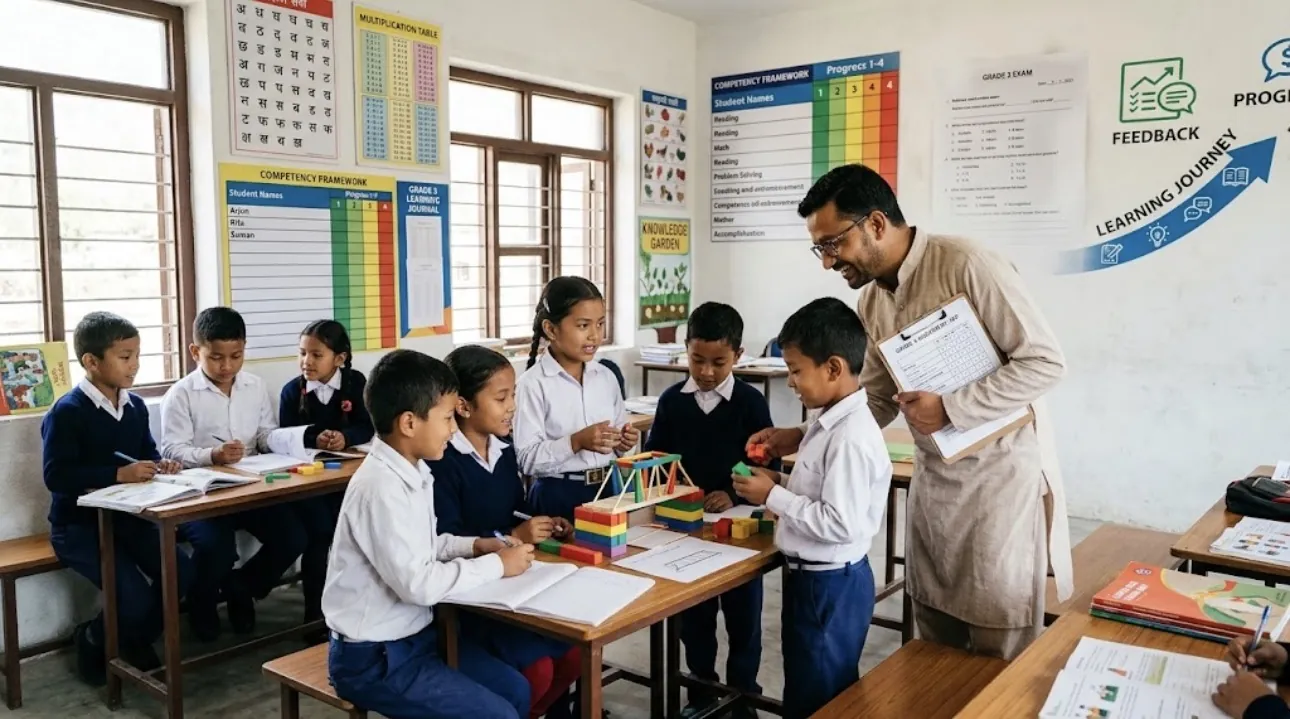
Primary Students Are Moving Away From Exams. Can Continuous Assessment Fill the Gap?
For a young child, an exam can feel like a big event.
There is a question paper. There is a time limit. There is pressure to finish. And there is usually a mark at the end.
But does one exam really tell us everything about what a child has learned?
Probably not.
A child may understand a lesson but struggle to write the answer. Another child may be nervous during an exam. Some children learn better by doing things, talking, drawing, reading, working in groups, or solving real problems.
This is why the recent move away from internal examinations up to Grade 5 in Nepal has started an important conversation:
If young children are not taking traditional exams, how should schools check their learning?
One possible answer is the Continuous Assessment System (CAS).
What Has Changed in Nepal?
In March 2026, the government announced that internal examinations would not be held for students up to Grade 5 from the next academic session. The decision has brought more attention to other ways of checking student learning.
But removing an exam does not mean removing assessment.
Children still need to be assessed.
Teachers still need to know who is learning, who needs help, and what needs to be taught again.
That is where continuous assessment can play an important role.
What Is Continuous Assessment?
Continuous assessment simply means checking learning regularly instead of waiting for one big exam.
A teacher watches what students do during normal classroom activities.
For example, a teacher may:
Ask questions
Listen to students read
Check classwork
Look at homework
Watch group activities
Check projects
Observe practical work
Talk with students
Give short exercises
Keep simple notes about progress
All these activities can tell the teacher something about a child’s learning.
The teacher can then use that information to decide what to teach next.
That is the real idea behind CAS.
No Exam Does Not Mean No Checking
This point is important.
Some parents may hear “no exams” and think students will no longer be checked.
That is not the purpose.
The goal should be to move from one-time testing to regular checking of learning.
Think about learning to ride a bicycle.
You would not give a child a written exam to find out whether they can ride.
You would watch them.
You would see where they have trouble.
You would help them.
Then you would watch again.
Learning at school can work in a similar way.
Why Could CAS Be a Good Option?
Continuous assessment gives teachers many chances to see student progress.
Suppose a Grade 2 student is having difficulty reading.
With a traditional exam, the teacher may simply see a low score.
With continuous assessment, the teacher can notice the problem earlier.
The teacher can ask:
Which words are difficult?
Is the child able to understand the story?
Does the child need more practice?
What type of activity helps the child?
The teacher can then provide support and check the child again.
This is more useful than simply writing down a low mark.
CAS Is Not Just About Marks
This is where continuous assessment is often misunderstood.
CAS should not become another way of collecting marks.
The important question is not:
“What score did the child get?”
The better question is:
“What does this information tell us about the child?”
For example, a teacher may find that a student:
Can read simple sentences
Has difficulty explaining ideas
Is good at group work
Needs more practice in writing
Understands numbers but makes calculation mistakes
This information is much more useful for teaching.
Teachers Can Find Problems Earlier
One major benefit of regular assessment is that problems can be found early.
Imagine a child who is struggling with basic reading.
If the school waits until the end of a term, several weeks or months may pass before the problem is clearly noticed.
But if the teacher regularly watches reading activities, the problem can be seen much sooner.
The teacher can then provide extra practice.
Early support can prevent a small learning problem from becoming a bigger one.
What Happens After a Student Struggles?
This is one of the most important questions about CAS.
Finding a problem is only the first step.
The next step should be support.
For example:
Student has difficulty with subtraction
↓
Teacher notices the problem
↓
Teacher gives extra practice
↓
Student receives feedback
↓
Teacher checks again
↓
Teaching is adjusted if needed
This is where remedial teaching becomes important.
CAS should help teachers decide who needs extra help and what kind of help may be useful.
Feedback Matters
A student does not always need another test.
Sometimes the student needs a simple explanation.
Instead of saying:
“Wrong answer.”
a teacher can say:
“Your method is almost right. Check the second step again.”
That small comment can help a child understand the mistake.
Good feedback tells students what they did well and what they can improve.
It also gives teachers a chance to talk with students about learning.
Parents May Need a New Way to Look at Progress
Parents are used to asking:
“How many marks did my child get?”
When traditional exams are reduced, parents may have different questions.
They may want to know:
Is my child learning?
What is my child good at?
Where does my child need help?
Has my child improved?
What can we do at home?
A good CAS system should help schools answer these questions.
Instead of giving parents only a number, schools can show a clearer picture of the child’s progress.
Primary Children Learn in Different Ways
Young children do not all learn in the same way.
One child may be good at writing.
Another may be better at speaking.
Another may understand a maths problem when using objects or pictures.
Another may learn well through group activities.
This is why classroom observation is important.
Teachers can look at different types of learning instead of depending only on written answers.
CAS Can Include Simple Classroom Activities
Continuous assessment does not need to be complicated.
A teacher can assess learning through normal classroom work.
For example:
Reading
Ask a child to read a short story and explain what it means.
Mathematics
Give a simple problem and ask the child to explain how they found the answer.
Language
Ask students to describe a picture or tell a short story.
Group Work
Observe how students work and communicate with classmates.
Project Work
Look at how students understand and complete a simple project.
These activities can give teachers useful information without creating another major exam.
But CAS Has One Big Challenge
There is a difference between having a CAS policy and using CAS properly.
Research in Nepal has found this gap.
A 2024 study of government schools in Bhaktapur found differences between policy expectations and classroom practice. The study looked at six schools, six head teachers, 18 teachers, and classroom practices. It highlighted issues around teachers’ understanding, feedback, remedial teaching, and workload.
Another study of Grades 1–3 in Nawalparasi found that teachers were using student-friendly activities and continuous assessment, but also identified a training gap.
So Nepal already has experience with CAS.
The question now is how to make it work better.
Teachers Need Support, Not Just Instructions
Removing exams can increase the importance of teachers.
Teachers need to know how to assess students properly.
They need practical training on:
Observation
Feedback
Learning indicators
Student records
Remedial teaching
Classroom activities
Student portfolios
Different ways of checking learning
Simply telling teachers to “use continuous assessment” is not enough.
They need examples and time to learn how to use it.
Workload Is Another Issue
Teachers already have many tasks.
If CAS means filling in many forms every day, teachers may see it as extra work.
That can weaken the whole idea.
A good system should make the teacher’s work easier.
Teachers should be able to record important information quickly and find it later when they need it.
This is one area where a simple digital system can be useful.
Can Technology Help?
Yes, but technology should not become the main focus.
A digital CAS platform can help schools keep assessment records in one place.
Teachers can record student progress.
Schools can review records.
Parents can get a better view of their child’s progress.
Reports can be prepared more easily.
For schools interested in a digital approach, CAS Nepal is one example of a platform designed for continuous assessment in Nepali primary schools. It says its structure follows the Curriculum Development Centre’s assessment forms and uses the same basic assessment approach.
The important point is that technology should support the assessment process.
It should not turn CAS into more paperwork on a computer.
CAS Should Follow the Curriculum
Continuous assessment should not be a separate activity added on top of the curriculum.
It should be connected with what children are expected to learn.
The Curriculum Development Centre (CDC) is the official body that provides curriculum-related resources in Nepal.
Schools and teachers should use official curriculum and assessment guidance when planning how they assess students.
This helps make sure that classroom assessment is connected with learning goals rather than becoming a collection of unrelated activities.
What Should a Good CAS System Do?
A useful CAS system should answer a few simple questions.
What has the child learned?
Teachers should be able to see the child’s current learning.
Where is the child struggling?
Weak areas should be easy to identify.
What support does the child need?
Assessment should help teachers decide what to do next.
Is the child improving?
Progress should be visible over time.
What should the teacher do next?
The information should help with teaching decisions.
If a system cannot help answer these questions, it may be collecting information without really improving learning.
What About School Accountability?
Some people may worry that removing exams will make schools less accountable.
This is a fair concern.
But accountability does not have to depend only on exams.
Schools can use student portfolios, teacher records, classroom work, learning progress, projects, observations, and other evidence.
The key is to have a clear and trusted system.
Schools should also explain the process to parents.
Parents need to understand how their child’s progress is being checked.
CAS Should Not Become “No Exam, More Paperwork”
This is probably one of the biggest risks.
If traditional exams disappear but teachers are asked to complete endless assessment forms, nothing really changes for teachers.
The child may have less exam pressure, but the teacher may have more paperwork.
That is not the goal.
The goal should be:
Less exam pressure + better classroom observation + useful feedback + timely support.
A Simple CAS Cycle
The whole process can be kept very simple:
Teach
↓
Observe
↓
Check learning
↓
Give feedback
↓
Help the student
↓
Check again
↓
Improve teaching
This cycle can happen many times during the school year.
It does not need to wait for an examination date.
What Nepal Needs Now
The decision to move away from internal exams up to Grade 5 creates an opportunity.
But the next step is very important.
Nepal needs to make sure teachers are ready.
Schools need clear guidance.
Parents need to understand the change.
Teachers need simple assessment tools.
Students need regular feedback.
And schools need a practical way to keep learning records.
Research has already shown that policy and classroom practice do not always match.
So this should not be treated as simply a change from one form to another.
It should be a change in how we think about children’s learning.
The Real Goal Is Not to Remove Assessment
The goal should be to improve assessment.
A child should not have to wait for a final exam to find out that they are struggling.
A teacher should not have to wait until the end of a term to discover a learning problem.
And parents should not have to wait for a report card to know how their child is doing.
Continuous assessment can make learning progress something that teachers, students, and parents can understand throughout the year.
Final Thoughts
Moving primary education away from traditional internal exams is a major change.
But the success of this change will depend on what comes next.
If schools simply remove exams, there may be a gap.
If schools replace exams with thoughtful, regular, and useful assessment, the change could be much more meaningful.
That is where Continuous Assessment System can play an important role.
CAS can help teachers see learning as it happens.
It can help find problems earlier.
It can give students useful feedback.
It can support remedial teaching.
And it can give parents a better picture of their child’s progress.
But CAS will only work if it is simple, practical, and properly supported.
The aim should not be to find a new way to give children marks.
The aim should be to find a better way to understand children and help them learn.
For Nepal’s primary schools, that may be the real opportunity behind moving away from traditional exams.