Student Portfolio: Meaning, Benefits, and Importance in Continuous Assessment
10 October 2026
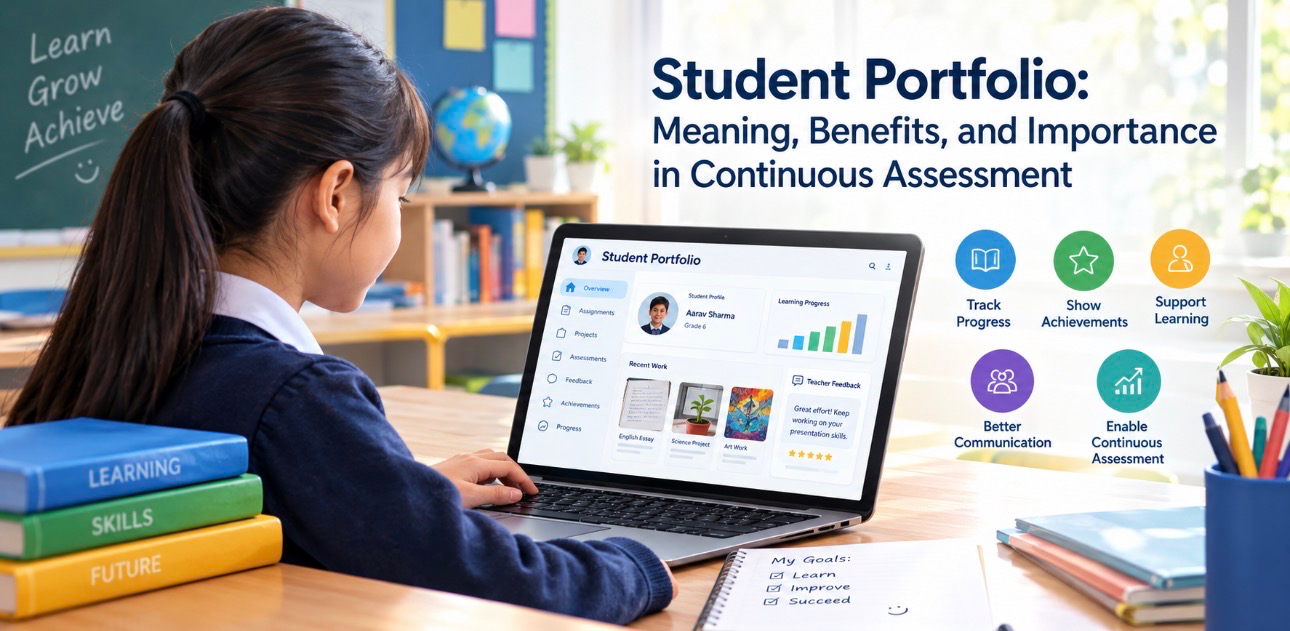
A student portfolio is a collection of a student’s work, achievements, and learning progress. It helps teachers understand what students have learned, what they do well, and where they need help.
In traditional education, students are often assessed through examinations and tests. However, exams cannot show everything a student can do.
A student portfolio provides a clearer picture of a student’s learning by collecting examples of their work throughout the school year.
When used with a Continuous Assessment System (CAS), a student portfolio helps teachers track progress, assess skills, and understand each student’s learning journey.
What Is a Student Portfolio?
A student portfolio is a record of a student’s learning and achievements.
It can include:
Classwork and homework
Assignments and projects
Photos of classroom activities
Practical work and presentations
Test and assessment results
Teacher feedback
Student achievements
Records of learning progress
For example, if a student completes a science project, the teacher can add the project report and photos to the student’s portfolio.
Later, the teacher can review this work to understand what the student has learned and how their skills have improved.
In simple words, a student portfolio shows what a student has learned and how they have improved over time.
Why Is a Student Portfolio Important?
Every student learns differently. Some students perform well in written exams, while others show their abilities through projects, presentations, creative work, or practical activities.
A student portfolio helps teachers understand these differences.
Its main benefits include:
Track student progress: Teachers can see how students improve over time.
Understand student strengths: Teachers can identify what students do well.
Find learning difficulties: Teachers can identify where students need extra help.
Record achievements: Schools can keep examples of students’ work and accomplishments.
Improve teaching: Teachers can use assessment evidence to plan better lessons.
Keep parents informed: Parents can understand what their children are learning.
Support continuous assessment: Teachers can assess students throughout the school year.
What Are the Different Types of Student Portfolios?
There are several types of student portfolios. Each has a different purpose.
1. Working Portfolio
A working portfolio contains a student’s regular work.
It may include homework, classwork, assignments, and project drafts.
Teachers use it to see how students are learning and improving.
2. Assessment Portfolio
An assessment portfolio contains work that teachers use to check whether students have achieved their learning goals.
For example, a teacher may collect a student’s writing assignments, maths activities, and science projects to assess their progress.
3. Achievement Portfolio
An achievement portfolio shows a student’s best work and important achievements.
It may include completed projects, certificates, presentations, and creative work.
4. Digital Student Portfolio
A digital student portfolio stores student work on a computer or online platform instead of in a physical folder.
It can include documents, photos, videos, assessment results, and teacher comments.
Teachers can access these records through a digital school system, depending on their permissions.
What Should a Student Portfolio Include?
A student portfolio should contain useful information about a student’s learning and development.
It may include:
Student name, class, and other basic information
Learning goals
Classwork and homework
Assignments and projects
Photos or videos of practical activities
Assessment results
Teacher comments and feedback
Student achievements
Examples of improved work
Records of skills and learning progress
Schools do not need to include everything. They should select work that helps teachers understand the student’s progress.
How Does a Student Portfolio Work in a Continuous Assessment System (CAS)?
A Continuous Assessment System (CAS) helps teachers assess students regularly throughout the school year.
Instead of depending only on final examinations, teachers can evaluate students through classroom activities, assignments, projects, practical work, and observations.
A student portfolio helps keep the evidence from these activities organised.
For example, imagine a student named Ram.
During the school year, Ram completes several activities:
He writes an English essay.
He completes a science project.
He gives a classroom presentation.
He participates in a group activity.
His teacher provides feedback on his work.
The teacher can add relevant evidence from these activities to Ram’s student portfolio.
After a few months, the teacher can review the portfolio to understand Ram’s progress, identify his strengths, and find areas where he needs improvement.
This makes assessment more meaningful because the teacher can look at different examples of Ram’s work rather than relying only on one examination result.
How Student Portfolios Support CAS
Classroom assessment: Keeps examples of student work.
Project assessment: Records projects and practical activities.
Teacher evaluation: Provides evidence to support teacher decisions.
Learning progress: Shows how students improve over time.
Feedback: Keeps useful teacher comments and suggestions.
Parent communication: Helps parents understand their child’s progress.
Student reporting: Provides information for progress reports.
In simple terms, CAS helps teachers assess students regularly, while the student portfolio keeps evidence of their learning in one place.
What Are the Benefits of a Digital Student Portfolio for Schools?
Managing student records using paper files can take time. Documents may become difficult to find, and keeping records organised can be challenging.
A digital student portfolio helps schools manage these records electronically.
The main benefits are:
1. Easy Record Management
Teachers can store student work, assessment evidence, and feedback in an organised digital space.
2. Quick Access to Student Information
Authorised teachers can review a student’s portfolio when they need to check progress or prepare an assessment.
3. Better Progress Tracking
Teachers can compare a student’s earlier work with more recent work to see how the student has improved.
4. Less Paperwork
Schools can reduce the need to store large numbers of physical documents.
5. Better Communication with Parents
Schools can share relevant portfolio information with parents so they can better understand their child’s learning.
6. Support for School Assessment
Portfolio records can help teachers review student performance and prepare progress reports.
Schools should also protect student information by providing access only to authorised users.
How Can Teachers Use Student Portfolios?
Teachers can use student portfolios through a simple process.
Step 1: Set Learning Goals
Teachers decide what students should learn and which skills they should develop.
Step 2: Collect Student Work
Teachers collect relevant assignments, projects, classroom activities, and other examples of learning.
Step 3: Review the Work
Teachers check whether students understand the subject and meet the learning goals.
Step 4: Give Feedback
Teachers explain what students have done well and what they need to improve.
Step 5: Track Progress
Teachers review student work regularly to understand how learning is developing.
Step 6: Share Progress with Parents
Teachers share appropriate information with parents to help them understand their child’s strengths and learning needs.
This process helps teachers use portfolios to improve learning rather than simply storing student documents.
Student Portfolio vs Traditional Assessment
Traditional assessment often focuses on tests and examinations. A student portfolio provides additional information by showing examples of learning collected over time.
Traditional Assessment
Often focuses on tests and examinations.
Shows performance at a particular time.
May not clearly show practical skills.
Usually focuses on marks and grades.
Provides limited evidence of the learning process.
Student Portfolio
Includes different types of student work.
Shows progress over time.
Can include projects and practical activities.
Records work, feedback, and achievements.
Shows how students learn and improve.
Both methods are useful. A student portfolio can work alongside examinations to provide a more complete picture of student learning.
How Does a Student Portfolio Help Parents?
Parents want to know whether their children are learning well and where they may need support.
Examination results can show marks, but they may not explain everything about a student’s learning.
A student portfolio can give parents a clearer picture by showing examples of their child’s work, achievements, and teacher feedback.
For example, parents may see how their child’s writing has improved over several months or how they have developed confidence in classroom presentations.
When a school uses a digital CAS platform, authorised parents can access relevant information about their child’s progress.
This helps parents understand their child’s learning and work together with teachers to support improvement.
Frequently Asked Questions (FAQs)
1. What Is a Student Portfolio?
A student portfolio is a collection of a student’s work, achievements, and learning progress.
2. Why Is a Student Portfolio Important?
It helps teachers understand student progress, identify strengths and weaknesses, and provide better support.
3. What Is a Digital Student Portfolio?
A digital student portfolio is an online or electronic collection of student work, assessment records, photos, projects, and feedback.
4. How Does a Student Portfolio Support Continuous Assessment?
It keeps evidence of student learning collected throughout the school year, helping teachers review progress and assess learning more effectively.
5. Can Parents View a Student Portfolio?
Yes. Schools can allow authorised parents to view relevant information about their child’s work and progress.
6. Can a Student Portfolio Replace Examinations?
No, not necessarily. It can work alongside examinations to provide a more complete picture of student learning.
7. What Is the Role of a Student Portfolio in CAS?
In a Continuous Assessment System, the student portfolio stores learning evidence that teachers can use to assess progress, provide feedback, and prepare reports.
8. Why Should Schools Use Digital Student Portfolios?
Digital portfolios help schools organise student work, track progress, reduce paperwork, and improve communication between teachers and parents.
Conclusion
A student portfolio helps schools understand student learning beyond examination marks.
It keeps examples of students’ work, achievements, activities, and progress in one organised place. Teachers can use this information to understand what students do well and where they need more support.
When connected to a Continuous Assessment System (CAS), a student portfolio becomes even more useful. Teachers can regularly collect learning evidence, review student progress, provide feedback, and prepare better assessments.
For schools, a digital student portfolio can make assessment records easier to manage and help teachers and parents work together to support students.
Simply put, a student portfolio is a record of what a student has learned, what they can do, and how they improve over time.