
Why rubric-based evidence helps teachers save time
24 August 2026
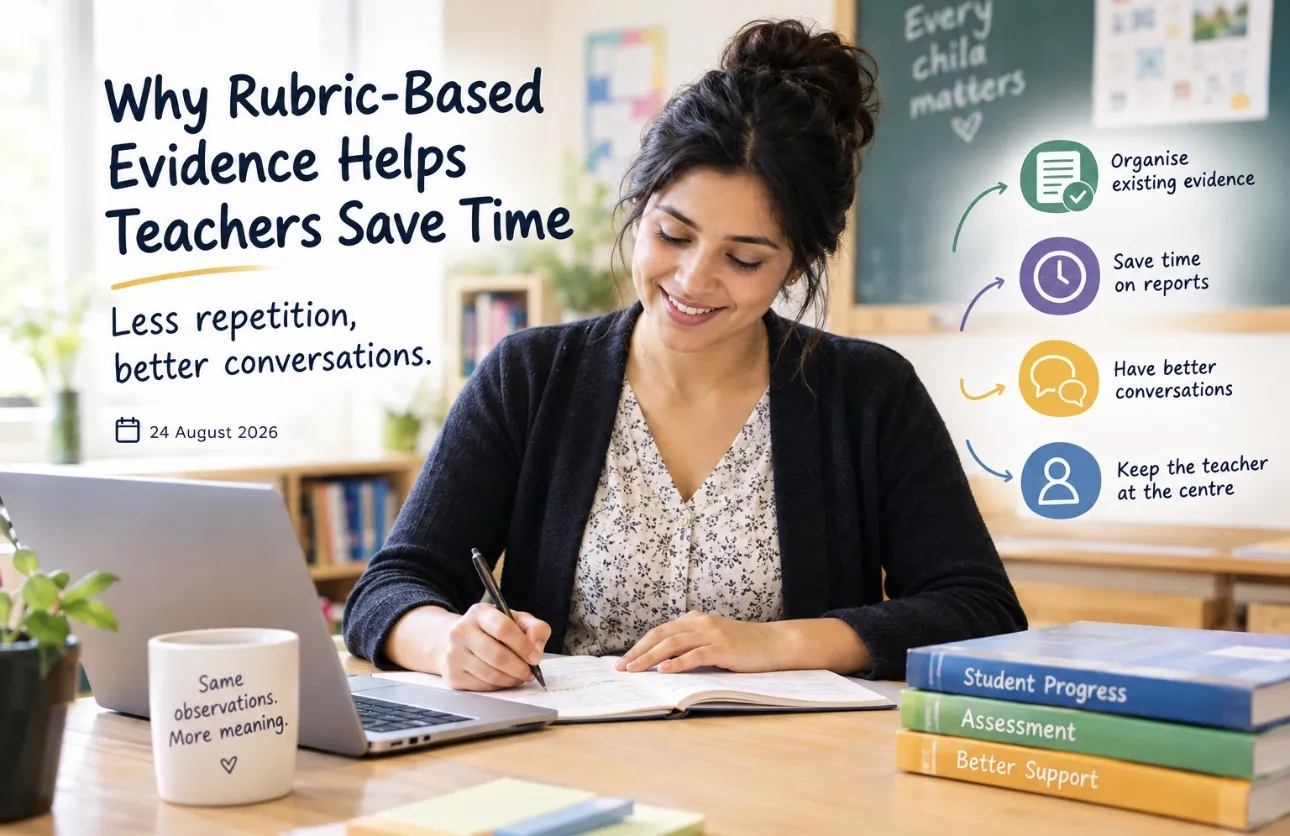
Why Rubric-Based Evidence Helps Teachers Save Time
Teaching is not only about standing in front of a classroom and explaining a lesson. Teachers spend a large part of their day observing students, checking classwork, asking questions, reviewing projects, giving feedback, and keeping records of progress.
All of this creates valuable evidence about how a child is learning.
But there is one common problem: keeping all this evidence organised takes time.
Teachers often have to look back through notes, worksheets, assessments, and previous comments when they need to prepare reports or discuss a student’s progress. Sometimes, the same information has to be written again and again in slightly different ways.
This is where rubric-based evidence can make a real difference.
A well-designed rubric gives teachers a simple way to organise what they already see and hear in the classroom. Instead of starting from a blank page every time, teachers can connect their observations to clear learning descriptors and then add the personal context that explains what is happening with that particular child.
The result is simple: less repetition, better conversations, and more time for teaching.
What is rubric-based evidence?
Before looking at how rubrics save time, it helps to understand what rubric-based evidence actually means.
A rubric is a structured guide that describes different levels or aspects of student learning. It may include areas such as communication, problem-solving, reading, writing, collaboration, creativity, or subject-specific skills.
For example, a teacher may have a rubric for a student’s writing skills. One descriptor might focus on whether the student can organise ideas clearly. Another might look at vocabulary, sentence structure, or the ability to explain an idea.
When a teacher observes a student completing an activity, that observation can be connected to the relevant part of the rubric.
This creates rubric-based evidence.
The important point is that the teacher does not need to create a completely new record every time. The rubric provides a consistent structure, while the teacher adds the details that make the evidence meaningful.
Teachers already collect a lot of evidence
One reason rubric-based evidence is useful is that teachers are already collecting evidence every day.
Think about a normal school day.
A teacher asks a question during a lesson. A student gives an answer.
A group works together on a project. The teacher notices that one student takes the lead while another needs encouragement to participate.
A student completes a piece of writing. The teacher notices that the ideas are strong but the sentences need more development.
During a class discussion, a normally quiet student suddenly explains an idea clearly.
These are all examples of student evidence.
The challenge is not necessarily collecting the evidence. The challenge is remembering it, organising it, and using it later.
A rubric gives teachers a place to connect these everyday observations to specific areas of learning.
Instead of having useful information scattered across notebooks, worksheets, emails, and separate notes, teachers can keep it connected to the learning area it supports.
That can make a big difference when reporting time arrives.
Less repetition means more time for teaching
One of the biggest advantages of rubric-based assessment is reducing repetitive work.
Teachers often need to write comments about students at different points during the year. Without an organised system, they may spend a lot of time searching for previous observations and rewriting similar comments.
For example, a teacher may have noticed in September that a student was beginning to contribute more confidently during group discussions.
By November, the student may be contributing regularly.
By February, the student may be explaining ideas clearly and responding to classmates.
If these observations are recorded in a structured way, the teacher can see the progress over time.
The teacher does not need to start again from scratch.
Instead, an earlier observation can provide a starting point, while new evidence can be added as the student’s skills develop.
This does not mean copying and pasting the same comment.
It means using evidence more efficiently.
The teacher can spend less time repeating basic information and more time explaining what has changed, why it matters, and what the student may need next.
Better conversations with students and parents
Saving time is important, but the value of rubric-based evidence goes beyond saving a few minutes.
It can also lead to better conversations about student progress.
A general comment such as “Good progress in communication” does not tell a parent or student very much.
A more useful conversation might explain that the student has become more confident when speaking in groups, can now explain ideas without as much prompting, and is beginning to respond to different opinions.
The rubric can help organize this information.
Teachers can use the descriptors as a common language for discussing progress. At the same time, they can add the real classroom examples that show what the descriptor looks like in practice.
This makes feedback more specific and easier to understand.
For students, it can answer an important question:
“What am I doing well, and what should I work on next?”
For parents, it can provide a clearer picture of their child’s development.
For teachers, it creates a useful record that can support future planning.
The evidence should remain human
There is an important point that should not be missed.
Technology can help organise evidence, but it should not replace the teacher’s judgement.
A student’s progress cannot always be understood through a score, tick box, or rubric descriptor alone.
Two students may demonstrate the same skill in completely different ways.
One student may be confident during class discussions but struggle with written work.
Another may rarely speak in front of the class but produce thoughtful and detailed written answers.
The rubric can help record these observations, but the teacher is still the person who understands the wider context.
This is why evidence remains human.
The role of technology should be to make the record easier to maintain, not to make decisions about a child without the teacher.
Teachers should remain responsible for interpreting evidence, understanding individual needs, and deciding what kind of support will help each student move forward.
Context matters
One of the limitations of a simple score is that it may not explain the full story.
Imagine that a student receives a lower result for participation.
That result alone does not explain why.
Perhaps the student was absent for several lessons.
Perhaps they were uncomfortable with the topic.
Perhaps they understood the work but were nervous about speaking in front of others.
Perhaps they communicate better through writing than speaking.
This is why adding context to rubric-based evidence matters.
A teacher can connect an observation to a descriptor while also recording the circumstances around it.
That small amount of context can make the evidence much more useful later.
When another teacher, parent, or school leader looks at the record, they are not only seeing a rating. They can understand what the teacher actually observed.
Rubrics create consistency without removing flexibility
Another benefit of using rubrics is consistency.
When several teachers are assessing similar skills, a shared rubric can provide a common framework.
This can make it easier to discuss student progress across a year group or subject.
However, consistency does not have to mean treating every child in exactly the same way.
A rubric should provide structure, not remove professional judgement.
Teachers still need the flexibility to record individual examples and explain unusual circumstances.
This balance is important.
The rubric provides the structure.
The teacher provides the meaning.
Together, they create a stronger record of student learning.
Reusable evidence can support the whole school year
One of the most useful features of organised evidence is that it can remain valuable over time.
An observation made during the first term does not necessarily stop being useful when the term ends.
It may help a teacher understand a student’s starting point.
Later evidence can then be compared with earlier observations to show development.
This creates a clearer picture of progress.
Instead of viewing assessment as a series of separate events, teachers can see it as an ongoing story.
For example:
● What could the student do at the beginning of the year?
● What changed after additional support?
● Which skills are becoming stronger?
● Where is the student still finding difficulty?
● What should the teacher focus on next?
Reusable evidence makes these questions easier to answer.
Less paperwork, more meaningful teaching time
Teachers cannot create more hours in the school day.
But they can reduce some of the repetitive administrative work that takes those hours away from teaching.
Rubric-based evidence is one practical way to do this.
When classroom observations are organised from the beginning, teachers do not have to spend as much time searching for information later.
They can quickly review what has already been observed, add new evidence, and use that information when planning lessons, preparing reports, or talking with parents.
The goal is not to create more records.
The goal is to make the records teachers already need more useful and easier to manage.
The teacher stays at the centre
Perhaps the most important idea is that rubric-based evidence should support teachers, not replace them.
A rubric can tell us that a student is demonstrating a particular skill.
A teacher can help us understand what that actually means for that child.
The teacher knows the student’s personality, learning habits, strengths, challenges, interests, and classroom experiences. That knowledge matters.
Technology can help store, organise, and connect evidence.
But the teacher remains the person who interprets the evidence and decides what happens next.
That human role should always remain at the centre of assessment.
Conclusion
Rubric-based evidence helps teachers save time because it turns everyday observations into organised, reusable information.
Teachers already collect evidence through questions, classwork, projects, discussions, assessments, and observation. A rubric gives that evidence a clear structure.
Instead of rewriting the same information repeatedly, teachers can connect observations to relevant descriptors and add the context that makes the evidence meaningful.
This can reduce repetitive work, improve reporting, and support better conversations with students and parents.
Most importantly, it does not have to make assessment less personal.
The technology can handle the organisation.
The rubric can provide the structure.
But the teacher remains the person who understands the child, interprets the evidence, and decides the right support.
That is where the real value of rubric-based evidence lies: not in replacing the human side of teaching, but in giving teachers more time and space to focus on it.